Blank Slates
Matthew 4:12-23
Now when Jesus heard that John had been arrested, he withdrew to Galilee. He left Nazareth and made his home in Capernaum by the sea, in the territory of Zebulun and Naphtali, so that what had been spoken through the prophet Isaiah might be fulfilled:
“Land of Zebulun, land of Naphtali,
on the road by the sea, across the Jordan, Galilee of the gentiles—
the people who sat in darkness
have seen a great light,
and for those who sat in the region and shadow of death
light has dawned.”From that time Jesus began to proclaim, “Repent, for the kingdom of heaven has come near.”
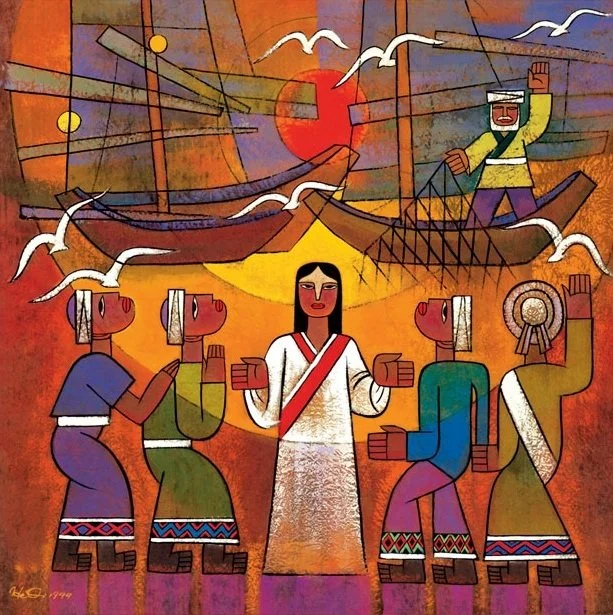
As he walked by the Sea of Galilee, he saw two brothers, Simon, who is called Peter, and Andrew his brother, casting a net into the sea—for they were fishers. And he said to them, “Follow me, and I will make you fishers of people.” Immediately they left their nets and followed him. As he went from there, he saw two other brothers, James son of Zebedee and his brother John, in the boat with their father Zebedee, mending their nets, and he called them. Immediately they left the boat and their father and followed him.
Jesus went throughout all Galilee, teaching in their synagogues and proclaiming the good news of the kingdom and curing every disease and every sickness among the people.
Like Jesus’ baptism that we talked about a couple weeks ago, this is another one of those stories there’s a version of in every gospel. And like we talked about a couple weeks, ago, when that’s the case, I like to look at what’s unique about the one we’re focused on on the given day. But earlier this week, I found myself struggling, and wishing I was preaching on Luke or John instead— in Luke, there’s so much drama, Jesus gives the fishermen so many fish that their nets break, and they’re amazed and bow down, and feel unworthy… in John, which is my favorite version of this, the first disciples meet Jesus at the baptism, and Jesus invites them to go to where he’s staying and have a conversation. The conversation lasts hours, and when they leave, they know he’s the savior. I guess I like this one because this is the most believable to me, and I just love imagining what they were talking about for all those hours indoors.
But today’s passage, as a couple people noted in Bible study last week, feels a little disjointed. There was even a comment that I’m inclined to agree with, that if you didn’t know what you were looking for, you might totally miss the fact that this is the moment in which Jesus does get his first disciples— the author reminds us of some geographical prophesy, and then all of a sudden, a couple young fishermen are dropping their work without a word, leaving everything behind to follow this strange new prophet. My kneejerk reaction to this is, initially, ‘yeah right.’ My more thought-out reaction is, that I guess we can assume that Jesus had this ultimate charismatic authority, and wouldn’t it be amazing if he came back today, walked into our place of work or our home and we just knew. We knew something as special. Because he’s Jesus, because he’s our savior, I think it’s safe to make this assumption. But even so, I was struggling with this one— and I’m going to chalk this up to my mood at the beginning of last week—I was recovering from the flu, before that I was recovering from travel… I guess I wasn’t really in the frame of mind to imagine being blown away by the mere presence of a peculiar stranger.
But then I started reframing this, started thinking about it all a little differently. One of the reasons I initially wasn’t especially moved by this passage, was that all we get are names. All we get are names and occupations—no background, no backstory, no drama. But one of my commentaries noted the fact that in this way, they can kind of represent any and all of Jesus’ followers from then to the present… they’re sort of blank slates— Jesus doesn’t find some specific person that fits some narrow niche… what we can take from this is that anyone can be a follower of Jesus. There are no requirements to be a follower of Jesus, except, simply, to follow—and to follow, to become a disciple, means to learn and to love.
And then, the more that I thought about it, the more compelling this is— we’re living in such tumultuous, uncertain, chaotic times—don’t we just want someone to come along and make it right? Don’t we want someone to come along and say, ‘leave this pointless drudgery behind, come follow me, I have all the answers, we can make all this violence stop.’
We’ve been looking for a savior, I think, to put an end to all that’s wrong with the world. Some have looked to our current president. Some have looked to other politicians, all over the spectrum. Some people look for public academics, artists, activists. Nothing’s worked so far. And we can argue about why, we can put blame on this person or that person, on the internet, on the media… but let’s remember—we have a savior. No, he’s not earthside right now, and no, we don’t have the privilege of physically walking alongside him and getting advice and sitting in rooms with him strategizing the bringing about of an earth as it is in heaven. And yes, that is a challenge. It’s a challenge to remember that we have a savior who transcends all, but who is not visible, not physically here. And then there’s one of those divine contradictions here too, right? Because we’re called to follow Jesus thousands of years after his presence on this earth, and yet we’re also called to do very real and tangible work in his name, right now, in the present.
“Follow me, and I will make you fishers of people,” says Jesus. And they drop their nets and go. The call is urgent. The call is in the present. The call is now. And this is the same as it ever was. The call is still the same now as it was then. Peter and Andrew, James and John could have been anybody. They were four middle-class young men toiling under an oppressive regime; toiling under the rule of those who did not understand them, who did not really care about them, toiling in an occupied land. And so when they saw Jesus they knew—they knew this is the way out.
The same is true now. In a flurry of social media posts last week, I saw one from the author and community organizer Latasha Morrison that stuck with me. She wrote,
The Church belongs to Christ, not to any political agenda or party. Our allegiance is to a Kingdom that transcends every flag and party. Whenever Christianity becomes a tool of domination, control, and power, it betrays Jesus.
Jesus’ first disciples were called because they were open to an alternative to the broken system under which they were living. Jesus’ first disciples were open to something that would transcend oppressive earthly powers, and would lift up the meek. And yes, the reality is, is that we have to work within our broken system to some extent to make this world better, of course; but we can’t get bogged down in drudgery, or in the information overload, or the overwhelm. We have Jesus’ call to guide us and his promise to sustain us, and that call goes beyond all the bureaucracy and overwhelm that tries to hold us back from doing what is right; that goes beyond a worldly system that only benefits the few—it is the good news of the kingdom, and earth as it is in heaven.
But yes… we have to work earthside and get down in the dirt to make this promise come to fruition.
There was an interview the other day on PBS with sociologist Tressie McMillian Cottom about all the exhaustion and overwhelm right now, and how to combat it— and there are all those surface-level pieces of advice about so-called “self-care” that involve withdrawing from all of it, taking a nice bath, that sort of thing (and don’t get me wrong, do this if you have to, but the point is, this ultimately isn’t effective). Cottom explains that we’re actually exhausted because we’re aware of so much, and we’re doing too little. She says that we get so much, just an onslaught of passive information, and then by contrast, we have very few opportunities to act. This is what exhausts us. This is what leads to despair—that combination of information overload, and feeling like if we can’t solve it all, we may as well not even try. But it’s actually when we get involved with a cause, when we are working alongside other people for something bigger and better than ourselves, that’s when we become energized. And if you’ve paid any attention to the news these past few weeks, we can see that’s true—in Minneapolis, where citizens people are being executed in the streets, the people are not backing down. They’re not giving into the reign of terror or the lies. Through the clouds of tear gas, they can still see a better world is possible, and so like Peter and Andrew and James and John, they drop what they’re doing to heed the call.
They were four young men, toiling the day away. They could have been any of us. We can all, we must all answer when we are called. Because just as we could be Peter or Andrew, James or John, we could also be Alex Pretti, or Renee Good. This is not the time to stand down. This is not the time to despair to withdraw. Christ’s call is louder than ever right now—his call to love, his call to peace…
Last week I talked about how in our small corner of the country, we are still called to be children of the light, for all people, for all states, nations, for the world, because God’s call is too big, too infinite, to try to do anything less. That remains true. This week, we hear God’s call from the mouth of Jesus— follow me. Follow me into danger and risk; follow me to show people of the way of love.
So amidst all the grief, the rage, the violence, let us remember—our allegiance is to Christ, and his call to peace. Our command is to heed the call of love. May we do so together. Amen.
