New Year’s Commitment
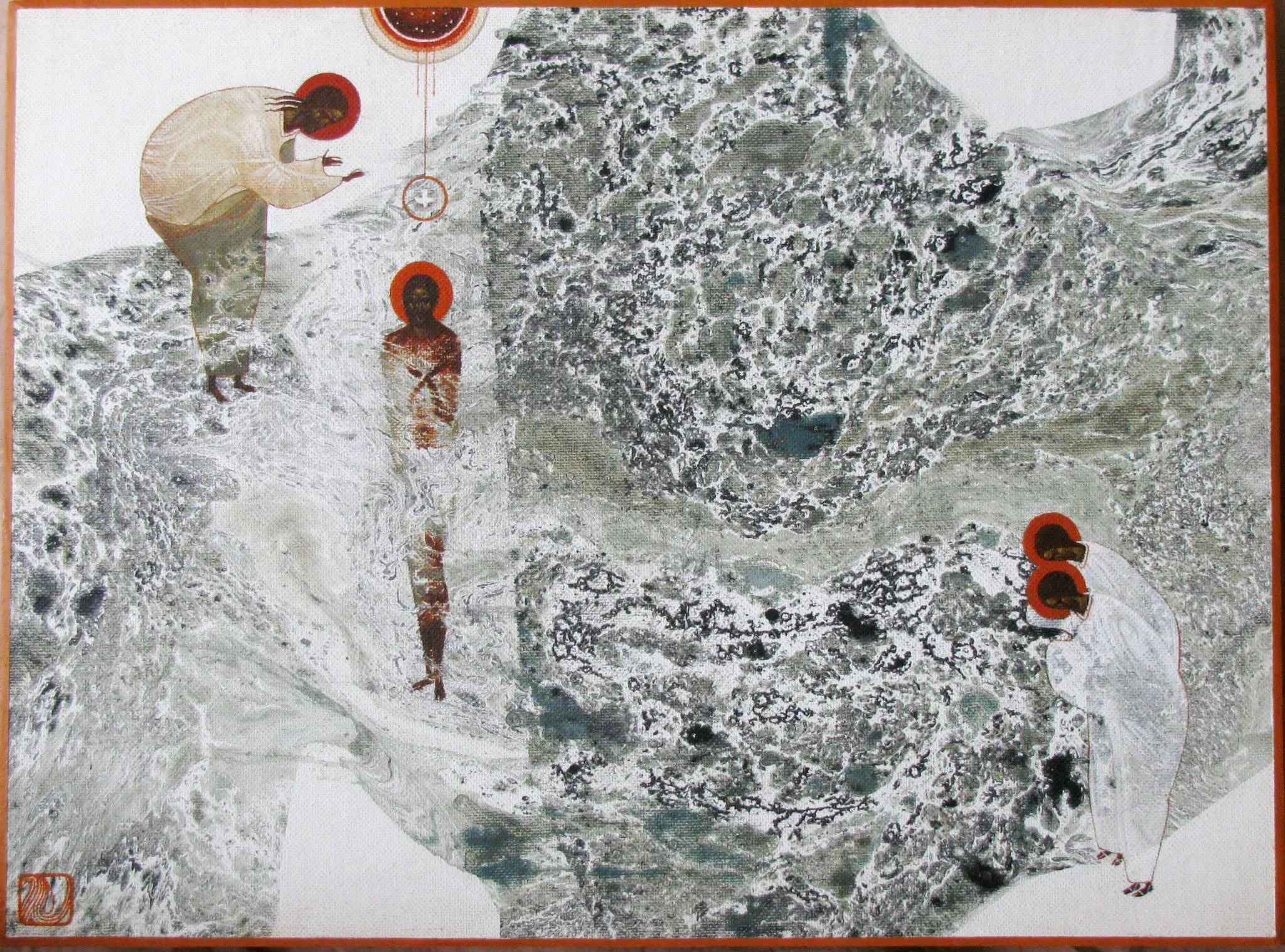
Matthew 3:13-17
Then Jesus came from Galilee to John at the Jordan, to be baptized by him. John would have prevented him, saying, “I need to be baptized by you, and do you come to me?” But Jesus answered him, “Let it be so now, for it is proper for us in this way to fulfill all righteousness.” Then he consented. And when Jesus had been baptized, just as he came up from the water, suddenly the heavens were opened to him and he saw God’s Spirit descending like a dove and alighting on him. And a voice from the heavens said, “This is my Son, the Beloved, with whom I am well pleased.”
The story of Jesus’ baptism is present in all four Gospels—even the outlier, John. When this is case, I always look to what makes the one we’re talking about unique from the other three accounts—what makes this one different, what is in this one that’s not in the others. In Matthew’s case, the most glaring difference is the fact that Jesus and John have a conversation. John is reluctant to perform this ritual because he understands that Jesus is above him, that Jesus is the Messiah; he’s worried it would be blasphemous. But Jesus explains to him that this must happen to “fulfill all righteousness.” And righteousness here, can be literally translated also as justice.
To us, reading this ancient text today, this might not seem like a big deal—perhaps it even makes sense to us. We know Jesus is the Messiah, so of course John would be confused about Jesus’ needing to be baptized; after all, why would a perfect savior need this ritual just as common humans do? But this wasn’t placed in here just for the drama or the word count. This was kind of shoehorned in so that readers would understand that it was Jesus who was the Messiah, and not John. This was included to kind of knock people over the head with the fact that Jesus was the Messiah. This really kicks off Jesus’ ministry—it’s after this he is tempted in the desert and then travels around with his disciples talking in riddles and blowing people’s minds up until his death and resurrection. Jesus is rarely so clear or straight-forward in anything his says—so why did the writer of this first gospel make this decision?
A few months ago, there were some articles going around about this new era of movies and tv, and about different streaming apps and services; in one essay from the magazine n+1, Will Tavlin writes,
Several screenwriters who’ve worked for the streamer told me a common note from company executives is “have this character announce what they’re doing so that viewers who have this program on in the background can follow along.”
So, if you have a movie on while you’re scrolling on your phone, you can still follow the story; so if you’re not looking at the tv you have on, you can hear some ridiculous dialogue like, “I’m walking into the room now,” or a character essentially describing the prior scene another character. It’s not good writing. And surely this must do a number on our own attention spans; and in addition, with these movies or tv shows streaming in the background, the company makes money on views and subscriptions, while producing more and more slop, so there’s little motivation to make good art anymore.
I bring this up because, in a way I initially found a little funny, I saw this dialogue between Jesus and John as a proto version of this expositional writing, of those obvious hit-you-over-the-head, telling-not-showing way of writing. As I alluded to earlier, there was so much confusion about who the Messiah really was—at this point, many people were following John believing him to be the Messiah. And many likely wouldn’t have believed that a Messiah would need to be baptized at all; many would have believed that his asking to be baptized would have negated any supremacy at all, thinking that submitting to this ritual would have been an admission of sinfulness or fallibility. So this piece of dialogue is Matthew making sure the reader is paying attention, making sure the reader understands. This is him making absolutely sure we can’t miss the fact that Jesus must be baptized to “fulfill all righteousness;” to fulfill all justice. And then, once we’re paying attention, the real action starts—Jesus is baptized, and then there’s this incredible theophany, this moment when the heavens open and the Holy Spirit appears as a dove, and it is made clear, beyond the shadow of a doubt, that Jesus is God’s beloved, the savior.
This incredible moment shows not just a miracle from the heavens, but it shows the commitment to his cause, to his call, that Christ has. When he is baptized, in the murk, in the muddy water by his strange cousin John, he is committing to his death. He is committing to a beautiful, world-changing, mind-blowing, but treacherous life and death. And he is doing this to fulfill all justice, for us. By being baptized, Jesus is making a commitment to walk alongside us in all of our joys and pains and sorrows, and that commitment continues forever and ever.
I’ve talked before about the fact that Chris and I have differing ideas when it comes to baptism: Chris doesn’t believe in infant baptism since he believes it should be a decision one consents to; I believe infant baptism is a commitment of the blood-family and the church-family to support and love that infant as the walk their journey, and is therefore fully appropriate. I obviously won that battle. That being said, I do understand the argument, and at times I find myself being convinced by it, especially when we look at our passage today as an example—our own savior making the intentional and conscious choice to be baptized in solidarity with the rest the broken and deeply fallible humanity.
One of my favorite theologian’s, Jurgen Moltmann’s, opinions on baptism is much closer to Chris’ than it is to mine. He wrote about something that he calls, “vocational baptism.” This was a conscious commitment to the work that Jesus, that our faith calls us to carry out. It’s a conscious commitment that’s a mirror image of Jesus’ in our story today—a commitment to all the good, the scary, and the magnificent that is the Christian journey in a broken world.
Now, we don’t have to get re-baptized, but we can still make this vocational commitment. As I wrote in my note to the church this week, this is a perfect time for this— because we can treat this commitment as a new year’s resolution on steroids. We can treat this as a real commitment to our faith and to this community in this new year and beyond, thinking long and hard about what these scriptures and this place and these people mean to us, what Jesus means to us, walking alongside us in this world.
But to make this commitment, we have to pay attention. This isn’t something we can do casually in the background. This isn’t something we can do half-heartedly. And this kind of commitment and focus is harder to come by than ever these days. We have companies like Netflix catering to it, in fact, encouraging this lack of attention, focus, and critical thinking for more views and subscriptions. There was a very timely (for me and this sermon) article from just yesterday in the New York Times by a professor and scholar of the history of science about this very issue It reads,
We definitely have an attention problem, but it’s not just a function of the digital technology that pings and beeps and flashes and nudges us ever closer to despair. It starts with the way we think about attention in the first place. An industry estimated to be worth $7 trillion views attention in the narrowest possible way: as something that can be measured in terms of device-engaged, task-oriented productivity, then optimized and operationalized and profitably controlled. That narrow view of attention has become so dominant that it even pervades efforts at resistance, including the countless well-meaning calls to “improve focus” or “avoid distraction.” In our efforts to liberate ourselves, we have become anxious accountants of our own attention.
And so how do we pay better attention in this world? How do we commit ourselves to our faith and building a better world in a world that’s pulling us in all the wrong directions, vying for and monetizing our attention?
Mystic and theologian Simon Weil (Vay) believed that “Attention, taken to its highest degree, is the same thing as prayer. It presupposes faith and love. Absolutely unmixed attention is prayer.” The answer, Church, as always, is love. When are able to truly focus on something, on anything— a conversation with a friend, walk in the woods, a movie, a chapter in a book, it presupposes love—love towards part of God’s creation.
At the beginning of our passage today, Matthew grabs our attention with this slightly stilted conversation between Jesus and John—a conversation that may seem obvious to unnecessary to us, but is meant to pull the reader in and realize that this moment is huge. Jesus was already born to us in human form, we celebrated that just two weeks ago; now he consciously takes the commitment to really be one with us—to get in the muck with us and walk alongside us. Our attention is then kept with the Holy Spirit as a dove appearing, and God making that incredible announcement, letting the world know, "This is my Son, the Beloved, with whom I am well pleased."
But after this moment, we can’t expect Matthew, or any of the gospel writers, or Jesus himself to use kid gloves with us anymore. After this moment, we need to make that commitment alongside Jesus—this commitment to pay attention and to focus and to work with love to bring about an earth as it is in heaven. Because even if you’re one of the lucky ones or strong ones who’s not addicted to your screens or mobile devices, there’s no denying the seemingly endless chaos of this world. There’s no denying the constant attempts to distract us, to subdue us, to depress us. It’s coming from all directions.
But remember—that’s what this space is here for. That’s what this community of faith is here for. That’s what you are all here for—we help each other re-center, we’re here to be grounded in what really matters, to be grounded in that vocational commitment of love that Jesus exemplified in his deigning to be baptized in the muck with all the rest of us mere mortals. It was a commitment to walk alongside the oppressed, the struggling, the broken; a commitment to lead with peace in a world that encourages violence; a commitment to focus all our attention with and to love— love towards all of God’s creation.
So no new year’s resolutions this year—this year, we’re making a vocational commitment. We’re making a commitment, in spite of all the news, in spite of all the hate and the grief, in spite of all the distractions, to really and truly focus on what matters, with faith and with love. Focus on a book, a movie; focus on a conversation with a good friend; focus on a quiet walk in the woods, listen to the chickadee’s song and be amazed and be in love. Pay attention to and focus on God’s creation in all the beautiful ways it exists in this broken world. And let us lead with that commitment to love as we venture into this new year. Amen.
