Luke 6:41-42
Why do you see the speck in your neighbor’s eye but do not notice the log in your own eye? Or how can you say to your neighbor, ‘Friend, let me take out the speck in your eye,’ when you yourself do not see the log in your own eye? You hypocrite, first take the log out of your own eye, and then you will see clearly to take the speck out of your neighbor’s eye.
I’m going to take some of my sermon time to play you a song, it kind of… set the stage— Game 6 of 86 by singer-songwriter Chris Acker…
(click here if you’d like to listen to the song with better sound quality, via youtube)
One was on two were out
Game 6 of '86 with a 3-2 count
Mookie Wilson hit a dribbler up the first base line
Bottom of 10 and the game was tied
Little roller went through Billy Buckner's legs
The winning run scored from second
Just minutes ago there was no one
Bob Stanley's wild pitch and it all went wrong
In Vallejo California public housing lawns
Bill and his brothers played wiffle ball
The boys and their sister and their mother Marie
Lived with the temper of their fathers drink
Marie worked for the highway patrol
Leonard was their Little League Coach
When his habit drove him off the road
Marie was left to raise 4 alone
So Bill gave himself to school and baseball
Big bushy eyebrows, 6 feet tall
Drafted the Dodgers in '68
He was in the lineup by the new decadeAggressive and competitive
A self critical perfectionist
Known not for his great success
Only for that ball he missed
One was on two were out
Game 6 of '86 with a 3-2 count
Mookie Wilson hit a dribbler up the first base line
Bottom of 10 and the game was tied
Let a life defined by one mistake
Be remembered as an unfair blame
They'd already thrown the win away
And there was still one more game to play…
When I decided to do this baseball sermon series, I knew I wanted to do a sermon about Bill Buckner. Because though Game 6 of the 1986 World Series was played a few months before I was even born, I grew up knowing what happened. I grew up knowing who Bill Buckner was. I grew up hearing about the shock and the grief and the anger that swept through New England on the night of October 25th, 1986. And I think I always knew on some level that the anger focused on Buckner’s infamous error wasn’t completely fair; but I also took it for granted as fact, that he lost the World Series for the 1986 Red Sox, even despite my dad (who had forgiven Buckner long ago) telling me the real facts of the game—it was in the local zeitgeist, it was simply part of the Boston area’s culture—Bill Buckner as the ultimate scapegoat, as the reason, at least that year, that the Red Sox remained under the wretched Curse of the Bambino.
And when I was trying to figure out what scripture passage could parallel the story of Bill Buckner, I was originally thinking it would be a passage about grace—about God granting us all unfathomable grace as we talked about at Breakfast Church last week, but also about how we need to extend that same grace to one another the best we can… but the passages was finding weren’t quite striking me. And then I read our short, kind of funny, hyperbolic metaphor. It’s one that comes at the end of a series of brief parables, metaphors, and sayings that are loosely related by the subject of not judging others. The one ***** just read for you really spoke to me—and not just because of the humor in it.
It made me think of the immediate aftermath of Buckner’s error. It made me think of fact that often, when tensions are high, it’s hard to see the forest for the trees, or the logs for the specks, if you will. It’s hard, when we’re overcome by anger or grief, or any other heightened emotion, especially a negative one, to see the whole person, to see the whole picture. The log in our passage likely stands for the sin of moral superiority; but the great thing about a metaphor is that it can be interpreted any number of ways. The log can stand for hatred, anger, debilitating grief; the log can stand for a loss of faith, a lack of hope. Any and all of those things can stop someone from seeing what really matters, and what’s really true. Any and all those things will drive someone to find a reason or an answer, whether it’s valid or not—it’ll drive someone to look for a scapegoat.
According to the late philosopher Rene Girard, scapegoating was once a crucial element of keeping a community together and peaceful, believe it or not. It was a way for the group to unite against the common enemy, to expel them from the community, and then have relative peace for a time. But this would all change as religion and culture evolved— the Bible began to tell stories from the point of view of the victims, the scapegoats themselves, which had been unheard of. And thus was born, the innocent scapegoat; and the ultimate example of this, of course, is Jesus Christ. And because of this evolution, Giard believes that it is impossible to go back to that primitive era of scapegoating to that at one time brought about peace and harmony… but, of course, that doesn’t mean people don’t still find innocents to scapegoat. And now, when they do, it does great harm. Our faith teaches us to look through the lens of the scapegoat, of the victim. Our faith warns us against mob rule, warns us against allowing ourselves to be driven by fear. Jesus changed everything— the Romans and the well-to-do Pharisees found a common enemy, a scapegoat, in Jesus… but we understand the story, not from the point of view of the power-hungry and fearful Romans or Pharisees, but from Jesus, and from his followers. We see the passion of Jesus from the point of view of the grieving and the oppressed. We see the big picture. We see the climate of oppression and subjugation that led to this type of action. We see why Jesus needed to live and preach and heal and love, and we see also why he had to die.
We have our own innocent scapegoats these days—we’re pitted against our neighbors by those who falsely claim the reason the job market is bad is because immigrants are taking your jobs; by people who falsely claim the miniscule number of transgender people in sports are ruining them; by people who falsely claim poor people are taking all our tax money. Sadly, the list goes on and on. But our faith tells us to not take this attempt to find a common enemy as face value. Our faith tells us to pry the logs from our eyes, to see the whole picture, to understand the truth as best we can. That way, we can see that it’s really the power-hungry billionaires that are destroying the job market; that way we can see that it’s gambling and greed that are existential threats to sports; that way we can see that it’s being beholden to money corporations instead of people is what’s making the poor poorer and the rich richer.
And that’s how we can look back and see that it wasn’t Bill Buckner’s error that lost the World Series for the Red Sox in 1986. As Chris Acker so beautifully sings, there was so much more to that game, to that whole series, and to Bill Buckner. The Red Sox manager John McNamara took out pitcher Roger Clemens, who was pitching a textbook game, in the top of the eighth inning, in favor of a rookie pinch hitter, Mike Greenwell. Greenwell struck out on three pitches. In the bottom of the eighth, the Mets would score one run to tie the game 3-3; then the ninth inning would be scoreless, forcing the game into an extra tenth inning. In the top of tenth, the Red Sox scored two runs. It was 5-3. Then the bottom of the tenth: Reliever Calvin Schiraldi got two quick outs. The Sox were an out away from winning the World Series. And then… the Mets’ Gary Carter singled, followed by Kevin Mitchell doing the same; now there were men on first and second, two outs. Ray Knight would now come up to bat... he was down in the count 0-2, but still managed to single. Bases were loaded. So When Mookie Wilson came up to bat, McNamara decided to take Schiraldi out and replace him with veteran pitcher Bob Stanley. And as Acker mournfully sings, “Bob Stanley’s wild pitch, and it all went wrong.” Two runners would score on that wild pitch, tying the game. Quoting Acker again, “They’d already thrown the win away” when that fateful ground ball went through Buckner’s legs. And of course, maybe the biggest indictment of all against the Red Sox and the scapegoating of Buckner: “There was still one more game to play.”
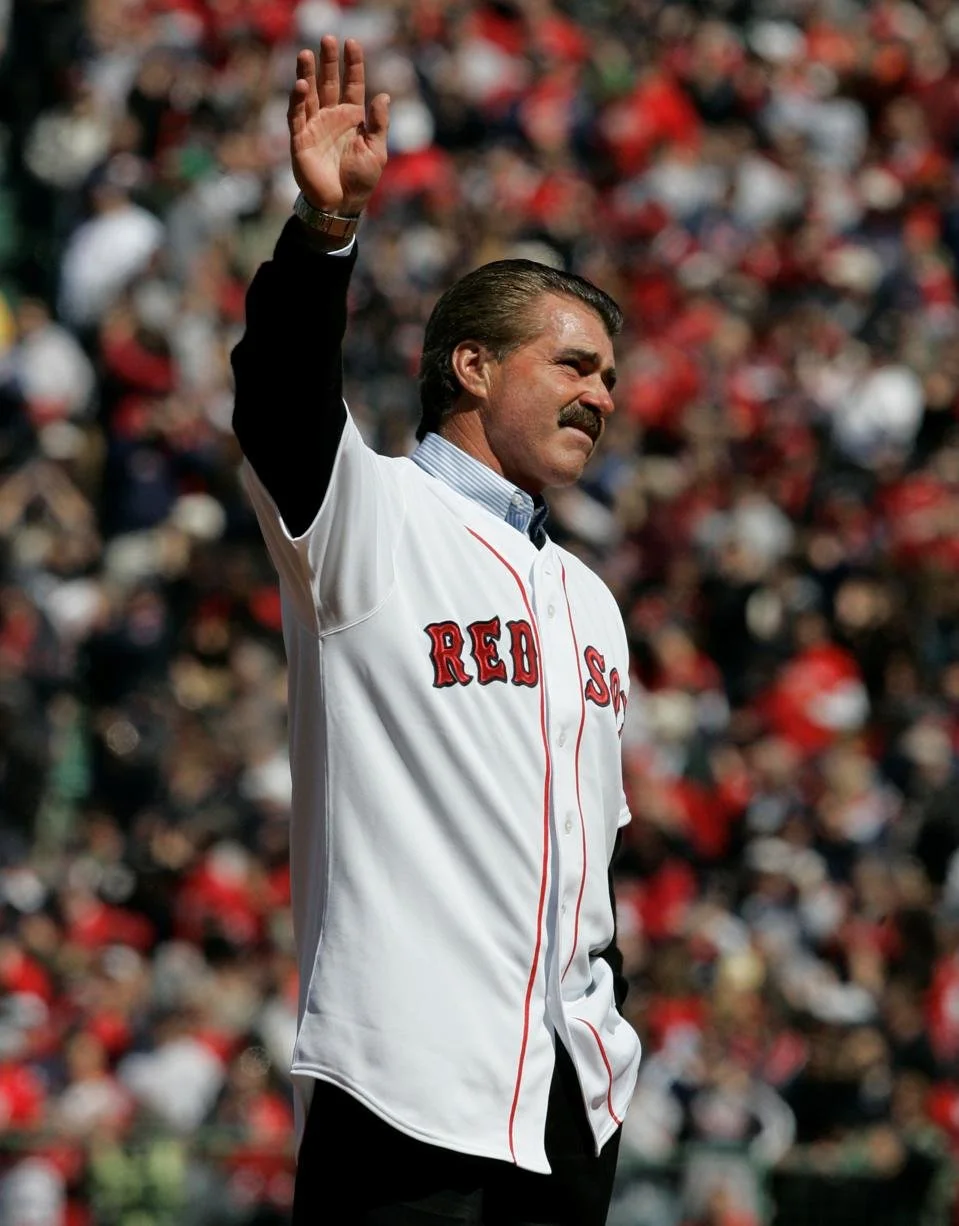
Bill Buckner died just a few years ago in 2019 at the young age of 69 after a long battle with Lewy Body Dementia. Though he did have a few stints coaching hitting in the majors, he lived most of the rest of his years on his ranch in Meridian, Idaho; and his wife confirmed that one of the main reasons they moved out there was that Meridian “isn’t a sports town. Nobody in this town would talk about Willie in a derogatory way.” But on April 8th, 2008, he came back to Fenway Park for the Red Sox home opener and threw out the ceremonial first pitch; and this was all part of a celebration of the Red Sox winning the 2007 World Series. Of the experience, Buckner said:
[It was] probably about as emotional as it could get. A lot of thoughts [were] going through my mind. I wish I didn’t have to walk all the way from left field, too many things. But just good thoughts, which is a nice thing. I really had to forgive, not the fans of Boston, per se, but in my heart, I had to forgive the media for what they put me and my family through. I’ve done that, and I’m over that and I’m just happy.
That day, the sold-out crowd at Fenway Park gave Bill Buckner a standing ovation. And let me tell you— if Boston Red Sox fans can take the massive logs out of their eyes and understand what really went down in that 1986 World Series, and can see the person, the whole person, Bill Bucker was—the incredible athlete, the perfectionist, the fighter who would play through injuries, who would hustle, who came from humble beginnings to about as high as you can get in professional sports—if Boston Red Sox fans can take the logs out of their eyes and see the truth of a heartbreaking loss, and see the man for the human he was, anything is possible.
And that’s what our faith teaches us—that anything is possible. Because our faith teaches us how to see clearly, teaches us not to judge others, not to scapegoat others; it teaches us how to be kind and understanding and compassionate. Our faith teaches us not to be driven or blinded by fear or hate or the unknown; it teaches us not to be overcome or blinded by grief or despair. Our faith teaches us to see—to see the whole situation, the whole person.
We can see from what happened to Bill Buckner that focusing on that speck, that error, led only to anger and despair. We see what happens when we refuse to look at the whole picture, refuse to confront the things that really lead us to failure, and it’s nothing good. So may we all take our own logs (because we all have them) out of our eyes. And may we all know that no matter how grim things seem, when we can see clearly, when we can see the path God leads us on, we will then see that there is always more game to play. Amen.
