Marvels
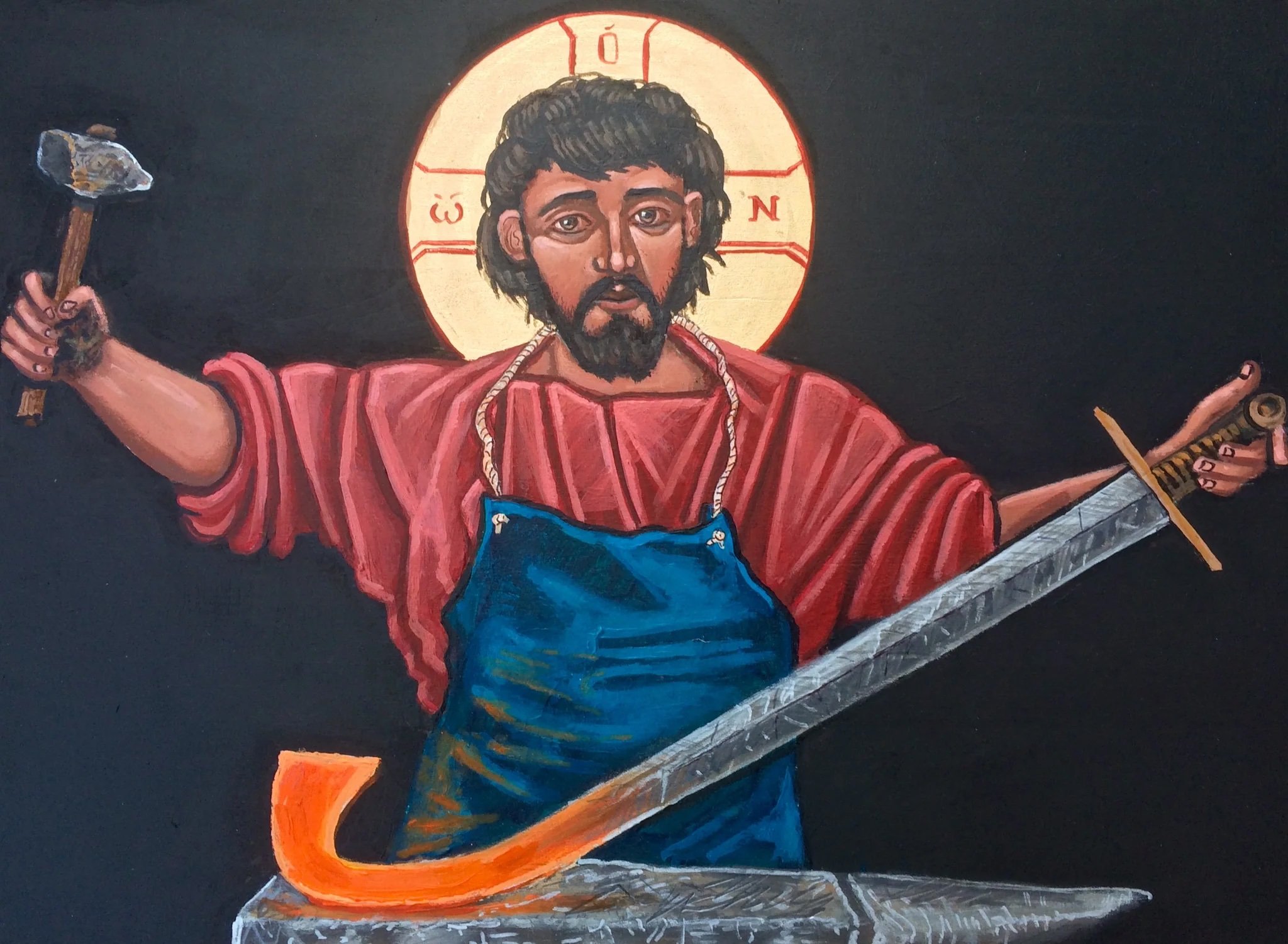
image credit: Kelly Latimore, Christ: Swords into Plowshares
Isaiah 2:1-5
The word that Isaiah son of Amoz saw concerning Judah and Jerusalem.
In days to come
the mountain of the Lord’s house
shall be established as the highest of the mountains
and shall be raised above the hills;
all the nations shall stream to it.
Many peoples shall come and say,
“Come, let us go up to the mountain of the Lord,
to the house of the God of Jacob,
that he may teach us his ways
and that we may walk in his paths.”
For out of Zion shall go forth instruction
and the word of the Lord from Jerusalem.
He shall judge between the nations
and shall arbitrate for many peoples;
they shall beat their swords into plowshares
and their spears into pruning hooks;
nation shall not lift up sword against nation;
neither shall they learn war any more.
O house of Jacob,
come, let us walk
in the light of the Lord!
It’s gonna get worse before it gets better is a phrase that seems to get thrown around a lot. We seem to always hear it in terms of the economy—whether it be inflation, tariffs, the job market, anything related to AI. Back in 2020, we heard it constantly in regard to the covid pandemic. It can apply to people personally in terms of grief, in terms of mental illness and substance use disorder… it’s a cliché that seems to have some truth behind it. But when you’re in that worse part, it can be hard to imagine the it gets better part.
That may be why Isaiah begins chapter two with such a beautiful promise of peace and hope— before he drops a bomb of judgment and bad news on them, he begins with the promise of God’s ultimate will for peace on earth— a world in which all will be drawn to and guided by the light of God, in which we will be one people, living in harmony… because after this, Isaiah really lets his people have it… he reminds them that they have abandoned their values in favor of “diviners” and “soothsayers” because, v.7, “their land is filled with silver and gold, and there is no end to their treasures.” And this idolatry of wealth will lead to war. This judgement and warning from Isaiah after the hope and peace of our passage for today, was all a precursor to the Syro-Ephraimite War, a war that would ultimately cause more trouble and conflict for the kingdom of Judah. So this is the getting worse part—greed, idolatry, war.
But it’s smart to lead with the hope— to start the prophesy with the fact that this will all come to an end, and things will get better, but before that can happen, we will have to face this violence that we have brought upon ourselves… to know that though we have brought this violence upon ourselves, we still have the opportunity to turn it around and to follow the light of the Lord, that this beautiful world of swords into plowshares and spears into pruning hooks is possible.
The mathematician Alexander Grothendieck was believed to be the greatest mathematician in the world during his lifetime, if not the greatest one in history. In 1958, he was doing groundbreaking research at the Institute of Advanced Scientific Studies in France—his goal was to “re-establish the foundations of geometry and unify all the branches of mathematics.” This was his ultimate goal—to find a universal language that would change the world. But in the late 1960s, everything changed. During his travels lecturing, he made a stop in Vietnam, lecturing at a university that would later be destroyed by American bombs, killing dozens of students and several professors. In Benjamin Labatut’s semi-fictional book, When We Cease to Understand the World, he writes of this time in his life, stating that Grothendieck believed “It was not politicians who would destroy the planet…but scientists…who were ‘marching like sleepwalkers towards the apocalypse.’”[i] Not long after this, he would renounce his practice of mathematics in protest of what he believed was the unthinkable evil and violence it made capable. Grothendieck all but fell off the face of the earth. He eventually became a hermit living in the middle of nowhere in the French Pyrenees, only ever seen by neighbors in his garden, with a long, unruly beard, wearing something akin to a monk’s habit. He lost most contact with the outside world, and at the time of his death, hadn’t even spoken to his children for over twenty years.
After his death, his family began going through his writings from his decades in solitude, and according to an article from The Guardian from about a year and a half ago, his final writings were “Far removed from conventional mathematics, [rather] Grothendieck’s final studies were fixated on the problem of why evil exists in the world.” All these years of seclusion and isolation, he never stopped trying to right the wrongs that he believed his own studies had helped create. He never stopped wondering and, in his own deeply broken way, working for a world without evil, trying to turn the tools of math, philosophy, and metaphysics from tools of evil in the world to tools of good.
Now, one of the reasons this article was written so recently, despite being about a hermit-mathematician who died in 2014, is because it had recently become public knowledge that the Chinese telecommunications company Huawei was looking into one of Grothendieck’s most groundbreaking discoveries to assist in their development of… you guessed it—AI. The author of the Guardian article writes, “Matthieu Grothendieck (Grothendieck’s youngest son) is clear about whether his father would have consented to Huawei, or any other corporation, exploiting his work: ‘No. I don’t even ask. I know.’”[ii] Perhaps it is a blessing that Grothendieck is not here to see his work, work that he believed would be a unifying force, used for something so morally corrupt—but I guess for us, still here on earth, still being forced to confront these strange new tools that contribute to so much confusion and violence, this is goes along with the it’s gonna getting worse part.
But hey, this is a sermon about hope! And we always, always have the promise of the possibility of an earth as it is in heaven. We always have the hope of the reality of being able to walk in and be guided by that light. But we have to work. And we have to wait. And we have to be creative.
And Jesus is the ultimate example of this creative, mind-blowing work—because Jesus comes to earth to turn everything on its head. Jesus, the ultimate king, born to homeless migrants amidst the animals; raised by a humble carpenter; growing into a savior who bucks all norms and turns traditions inside out—who will remind people upon his return, just as you did to the least of these, you did to me. The first shall be last and the last shall be first. But… it gets worse before it gets better. Even so, that doesn’t mean we can’t start making things better now.
Our passage for today tells us what a bit about what a perfect world looks like— it’s one in which swords will be beaten into plowshares, spears into pruning hooks. Tools of violence and death turned into tools of sustenance and life. Isaiah lived in a world in which a land filled with silver and gold, and chariots and horses was prioritized over justice for his own people of Judah, much less for all people. Isaiah lived in a world in which it was more lucrative and logical to make tools of death instead of tools of life. And yet, he had a vision of a world in which only tools of life and love would exist, but not before those tools would do immeasurable damage as tools of violence.
Surely there is a better use for AI in our world than for surveillance, or the mimicry of true art or relationships. Surely there is better use for whatever incredible and almost unknowable equations Alexander Grothedieck discovered and worked on throughout his strange life, than to give more power to those who already hoard it. Though Grothendieck was obviously dealing with deep traumas and mental illness, though he had renounced his studies decades before, he spent his finals year trying to figure out the nature of evil in the world, still trying to figure out how to turn swords into plowshares. Perhaps there was still some hope in him after all. Perhaps he wasn’t actually ready to give up the study of math because of all the evils other people had done with it. Perhaps there was a part of him who still believed in the ultimate promise of a better world.
I don’t know that anyone will ever be able to finish Grothendieck’s work—to figure out how to find a perfect common language to connect us all; or to figure out the true nature of evil and how to defeat it. But at the very least, at the very, very least—we, as Christians, as an Advent people, have this vision from Isaiah… this vision of a promise for a future in which all people are united, working in harmony together; a vision of a world in which war and violence are no more, and tools of war will become tools of life; a vision of a world in which all will walk in the perfect peace of the light of God; a vision which is made human and real in the coming birth of Jesus.
And we also have something Grothendieck did not—each other. A community. Pierre Deligne, a mathematician who was advised by Grothendieck, is skeptical that anything will come of his later writings and formulas, “Because” he says, “he had little contact with other mathematicians. He was restricted to his own ideas, rather than using those of others too.”[iii] If we want to work against the evils of the world, if we want to work to change the tools of violence into tools of comfort, we have to do so together. We have to be in community with one another and support one another, no matter how bad it may get before it gets better. And we have to remember what this season of Advent means—this season of waiting and preparing—this season of transforming.
Jesus, the king of kings, born to homeless refugees in a cold stable surrounded by animals and hay; at his birth, laid in a feeding trough repurposed, transformed, into a primitive bassinet; from his very birth, turning expectations and norms on their head; from his very birth, confusing and challenging oppressive emperors with his fragile infant being. Jesus’ life itself is a transformation of all that people thought was normal or right.
In her reflection for this first Sunday in Advent, theologian Kate Bowler writes,
Advent begins in the dark—with one small candle and a stubborn kind of hope. Not the shiny, everything’s-fine version. The gritty, keep-going kind.
This week, we start again. We wait. We bless what’s unfinished. Because the world is still a mess. And God is still coming.
We bless what’s unfinished. We bless those like Grothendieck, who, in spite of all their demons, never give up on attempting to find the solution to the problem of evil, to find a way to transform all that has gone wrong in the world to all being right. We bless the hard, seemingly endless work that needs to be done. We bless the fact that having hope isn’t easy in a world this broken, and that to maintain that stubborn hope, we have that faith that all will walk in the light someday, free from war and oppression. We bless the fact that we have each other— for support, to bounce ideas off of, to pray with, to laugh with, to cry with, to hope with in these dark times. We bless the fact that this candle is lit today to lighten the dark, to remind us that the dark never overcomes the light— to remind us that as we continue to light the way for one another on this journey, that the end of this journey isn’t a city of silver and gold, of chariots and fire, but rather a vulnerable infant, forcing us to think of power in a new way.
While many are skeptical that anything of substance will emerge from the scribblings of Grothendieck’s final days, Italian mathematician Olivia Caramello says, “We are at the very beginning of a huge exploration of these manuscripts. And certainly there will be marvels in them.”[iv]
This season of Advent, let us marvel at all the hope that may be found in the darkness; let us marvel of the transformed world that Jesus promised, that he came to usher in. Let us marvel at something so simple, yet so expectation-defying as a king come in something so full so possibility, yet in something so fragile, as a human infant. And let us marvel at the simple promise that no matter how bad things get, there will come a day in which we will all walk in the light of God. Amen.
[i] Labatut, Benjamín, and Adrian Nathan West. When we cease to understand the world. New York: New York Review Books, 2021.
[ii] https://www.theguardian.com/science/article/2024/aug/31/alexander-grothendieck-huawei-ai-artificial-intelligence
[iii] https://www.theguardian.com/science/article/2024/aug/31/alexander-grothendieck-huawei-ai-artificial-intelligence
[iv] https://www.theguardian.com/science/article/2024/aug/31/alexander-grothendieck-huawei-ai-artificial-intelligence
