Wisdom of Solomon 6:12-16
Wisdom is radiant and unfading, and she is easily discerned by those who love her and is found by those who seek her.She hastens to make herself known to those who desire her.
One who rises early to seek her will have no difficulty, for she will be found sitting at the gate.
To fix one's thought on her is perfect understanding, and one who is vigilant on her account will soon be free from care,
because she goes about seeking those worthy of her and she graciously appears to them in their paths, and meets them in every thought.
*****
Matthew 25:1-13
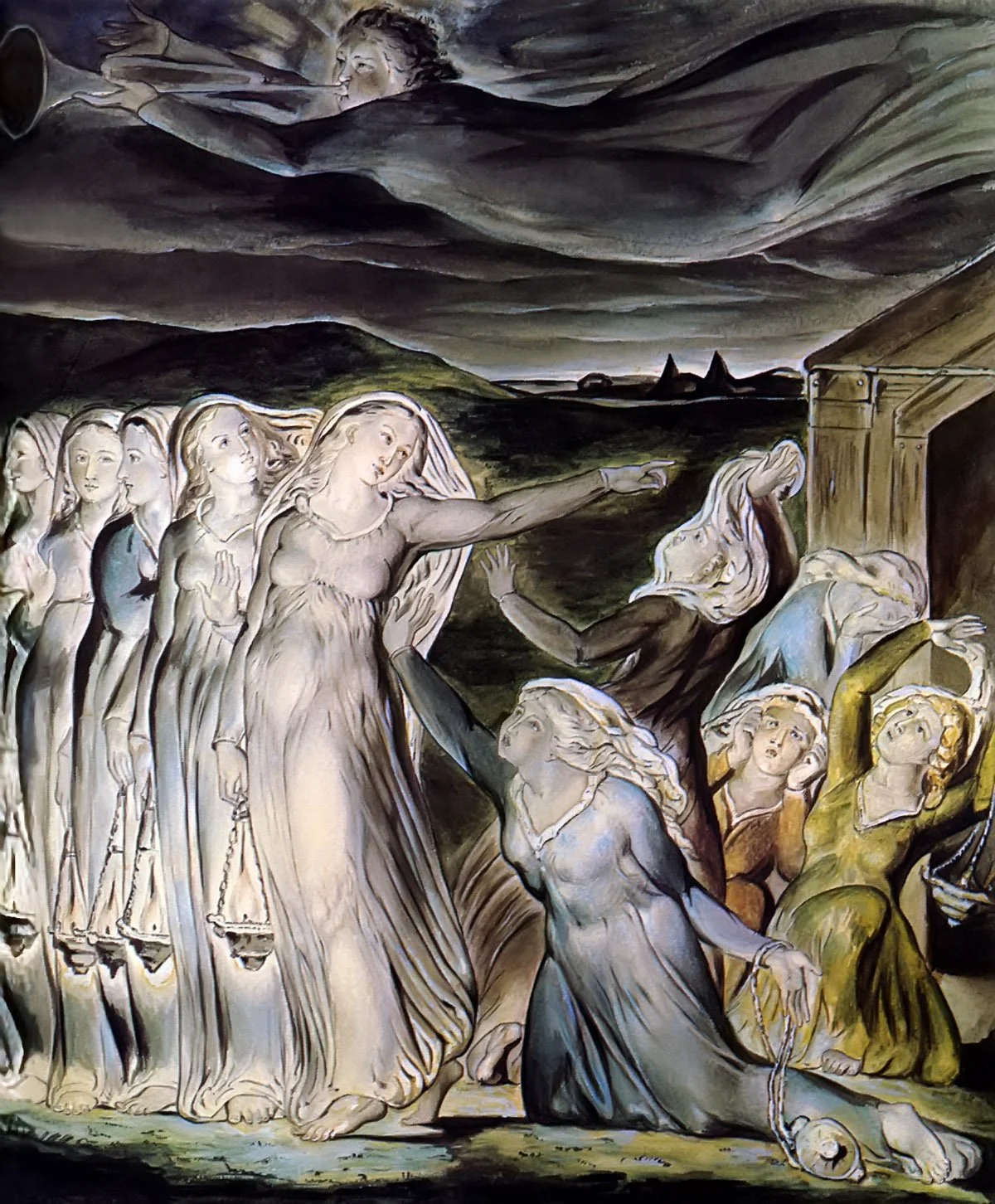
“Then the kingdom of heaven will be like this. Ten young women took their lamps and went to meet the bridegroom. Five of them were foolish, and five were wise. When the foolish took their lamps, they took no oil with them, but the wise took flasks of oil with their lamps. As the bridegroom was delayed, all of them became drowsy and slept. But at midnight there was a shout, ‘Look! Here is the bridegroom! Come out to meet him.’ Then all those young women got up and trimmed their lamps. The foolish said to the wise, ‘Give us some of your oil, for our lamps are going out.’ But the wise replied, ‘No! there will not be enough for you and for us; you had better go to the dealers and buy some for yourselves.’ And while they went to buy it, the bridegroom came, and those who were ready went with him into the wedding banquet, and the door was shut. Later the other young women came also, saying, ‘Lord, lord, open to us.’ But he replied, ‘Truly I tell you, I do not know you.’ Keep awake, therefore, for you know neither the day nor the hour.
About a year and a half ago, I did a Summer sermons series on the book of Proverbs, and the series started with a sermon on a beautiful poem, from Proverbs chapter 8, personifying Wisdom as a curious, loving, and deeply kind woman, shaping earth and its people alongside God: “when [God] marked out the foundations of the earth, / then I was beside [God], like a master worker,…/ playing in [the] inhabited world / and delighting in the human race.” The sermon I preached was about, not just the fact that Wisdom seems to exemplify the same love and joy and pride in humanity as God does, but also, the accessibility of Wisdom—the fact that Wisdom is available to all. And that’s exactly what our apocryphal passage from the Wisdom of Solomon today tells us—that she’s found by all who seek her; that she wants to be found, that people don’t just seek and find wisdom, that she seeks them too.
And the reason I wanted to read this passage alongside out parable today, continuing along in our Gospel of Matthew, is because I think we need that reminder when we’re reading this… kind of brutal story—this story of what should be a joyful day and night, turning into a tragedy, with five young women excluded from the celebration, exiled in darkness. We need a reminder that this isn’t how it has to be—that we don’t need get ourselves exiled because we didn’t prepare; that we don’t need to sit in darkness feeling left out. The horrific rejection and exclusion that happens in this story, in fact, really isn’t Christlike at all, and it’s really hard to reconcile this text with what we’ve talked about the past two weeks—loving our neighbor as ourselves and working and voting for a world in which no one is excluded, ever. But we have to remember—Jesus speaks in parables and riddles constantly, and even in his day, these stories were not meant to be taken literally. They’re all metaphors, allegories, symbols— he talks this way to force us to think critically, and creatively, to think differently about the world the people in it. And this is by far not the only time one of Jesus’ parables doesn’t have a happy ending— he’s essentially using shock value to try to get his point across… and what is his point, you might be wondering, as you imagine these poor young women sitting in darkness, eavesdropping on music and drinking and merriment on the other side of the door… and that’s a great question! We don’t really know. This is an especially confounding parable, because while it’s pretty straightforward in regards to the fact that it tells you exactly who’s wise and did the right thing, and who’s foolish and messed up, there’s little else we know for sure. The bridegroom, for instance, could be Jesus, or he could God; the bridesmaids could be any Jesus-followers or the church as a body. The oil is thought by many (myself included) to be good deeds or good works; but it could also be something as simple and broad as faith. The event this all symbolizes could be Jesus talking about himself in the future and his second coming, or it could be a more general Old Testament prophesy of God’s final judgement. In the end, it might all be kind of irrelevant. Jesus tells as dramatic story to get our attention and to get a point across, and that point is to always be prepared because we don’t know when a huge crisis will happen; we don’t know when we’ll be faced with something that will truly test our faith and our humanity.
But one thing is certain—we have to make sure we are always seeking wisdom. We have to be sure we remain curious and questioning and attentive to the world around us. It’s when we stop being curious, when we stop trying to seek out wisdom and answers, when we stop trying to figure out what’s right and what’s wrong, what’s good and what’s evil, that we’re left in the dark.
Two years ago, after the election results that I know disappointed a lot of people, one of the things I tried to make very clear, was that the work we’re called to, the just and peaceful world we are called to prepare and work for, does not change. The work never changes. Two years ago, I tried to convey the fact that we couldn’t despair; we couldn’t stop trying to think creatively about how to better this broken world… and the same principles are as true now as they were then. Regardless of your feelings about the results of Tuesday’s midterms, the work that we’re called to doesn’t change. We can’t get complacent or lazy. Last week in my plea for all who are able, to vote, I made it clear that though voting is deeply important, a politician won’t save us in this broken system. We have to continue the work of love, of peace, of compassion, regardless of who’s in power. We have to work as hard as ever. We have to push and we have to ask questions and we have to wonder how we can get things done, and how we can make this world a better, more compassionate place for all people.
Already, the arguments are starting about who should be leading in this new era; what the priorities should be, even who should be punished and when. There’s a blame game (there always is during this seismic shifts), idea of enemies and allies proliferating, wondering where we go from here. And again, for us, as Christians, it bears repeating—our work does not change. We remain guided by the principles of Love, of justice, of wholeness and community. And we, even in these relatively progressive mainline Protestant churches and traditions can’t become complacent just because it seems that we have some representation on the national level in the political realm. And we also can’t give into the temptation to continue to fall into an us vs. them mentality. Which, when we’re looking at our scripture passage today, that’s something that feels hard to reconcile or avoid when we’re presented with a story of the wise vs. the foolish. But the point of this scripture passage is this: it does not have to be this way. Nothing has to be this black and white, we don’t have to live in an us vs. them world. We can all celebrate together, we can all be invited to the wedding party, as long as we strive for wisdom, as long as we remain open, compassionate, curious, and creative.
The political writer John Ganz wrote this week about the word nemesis, a word that in our modern day has morphed into a pretty negative word that means something akin to an arch-enemy. But in Greek mythology, Nemesis was actually the goddess of restoring balance. She was the goddess of balancing the woes and sins of hubris and arrogance. And we can see how the world nemesis could get flattened into an us vs. them, me vs. you ideology. But, according to Ganz, what it ultimately is, is a feeling of “offended justice.” Aristotle differentiated it from the concept of envy, as it’s more an idea of righteous indignation,[i] and remember just last week we talked about Jesus righteous anger— “…woe to you, scribes and Pharisees, hypocrites! For you lock people out of the kingdom of heaven,” Jesus says in Matthew 23:13. Jesus doesn’t want people locked out in the dark. Jesus doesn’t want to have a world where there’s one group against another. The story that Jesus presents in this parable is an extreme one, one that doesn’t have to happen, one that won’t happen as long as think creatively, think differently about how to be the church in the world, and about how be human in the world. And it’s one that won’t happen as long as we keep our sights set on joy.
While the focus of the parable of the 10 bridesmaids is the fact that the foolish ones are cruelly rejected, let’s wait take a moment and recognize what’s happening on the other side of that door… a wedding celebration. Think about everything a wedding celebrates: joy, unity, commitment, and of course, love. The goal is joy. The pathway to getting there is guided by a constant seeking of wisdom. And the gift of all of this is a love that had no end.
And to get to that joy, we need to always be ready and remain vigilant. We need to keep awake and alert to, and curious about the needs of others. We must never stop, no matter who is in power, working for the sake of others, working to bring God’s peaceful kingdom here on earth. We must never stop working for a world in which utter and total balance is restored, the balance of Eden, in which every single person is equally valued and loved and full of joy.
We must never let our muscles of wisdom, compassion, or curiosity atrophy. Just as we can’t give into despair or complacency, nor can we outsource our questions and curiosity to machines in this age of AI. Wisdom seeks us out. It wants us to see it, to find it. We can’t blind ourselves to it, and allow ourselves to left in the dark, grasping for some clue about how we got there and how we could ever get out.
A few weeks ago, in my weekly note to the church, I wrote about Frankie’s why phase, a phase she’s very much still in. She’s constantly asking why about so much that we take for granted, that’s common knowledge to us, but when I’m asked why that’s the case, I find that I don’t have an articulate or satisfying answer; sometimes I don’t have any answer at all. But whether or not I have the answer, I find myself in awe of the types of questions she asks, and I find myself wondering why about so much I’ve taken for granted myself. In Matthew 18, Jesus’ disciples come to him and ask, “Who is the greatest in the kingdom of heaven?” Jesus replies, “Truly I tell you, unless you change and become like children, you will never enter the kingdom of heaven.” And yet in our passage today, we have the wise who enter the metaphorical wedding party, and the foolish who are rejected. Jesus, as we know, changed the world by turning societal norms and preconceived notions on their heads. Children are constantly seeking wisdom, constantly asking questions about the world around them. They are constantly questioning and wondering why things are the way they are, and why they have to be that way. We would do well to take a cue from the children among us— to be curious and on our toes in ways we maybe haven’t been or haven’t tried to be in a long time. If we combine the wisdom of our years and experience with the curiosity and wisdom-seeking of a child, we will be unstoppable.
In his commentary on the parable of the ten bridesmaids, Dan O. Via, he writes, “When a crisis is not responsibly met, the opportunity for further action may be cut off.” The door may by shut on us—if we stop asking questions about climate change; if we stop being curious about the people around us; if we stop questioning and pushing back on unjust laws and policies. We may miss out on the celebration and the joy. But Jesus doesn’t want this, despite how jarring our parable today seems on the surface. To gain the wisdom necessary to be prepared, we have to humble ourselves a bit, let go of our own hubris, and wonder why about the things we do not know. We have to ask questions and be open to the unknown. Whether we’re 3 or 93, we have to be curious and never stop seeking out wisdom, never get complacent or resigned, never give into despair or hopelessness.
Our work stays the same, regardless of who is in power. Our work stays the same, regardless fo what we know or do not know. And that work is to seek wisdom, to be curious, and humble and prepared… and the result of that work is an earth as it is in heaven. Amen.
