Seeds
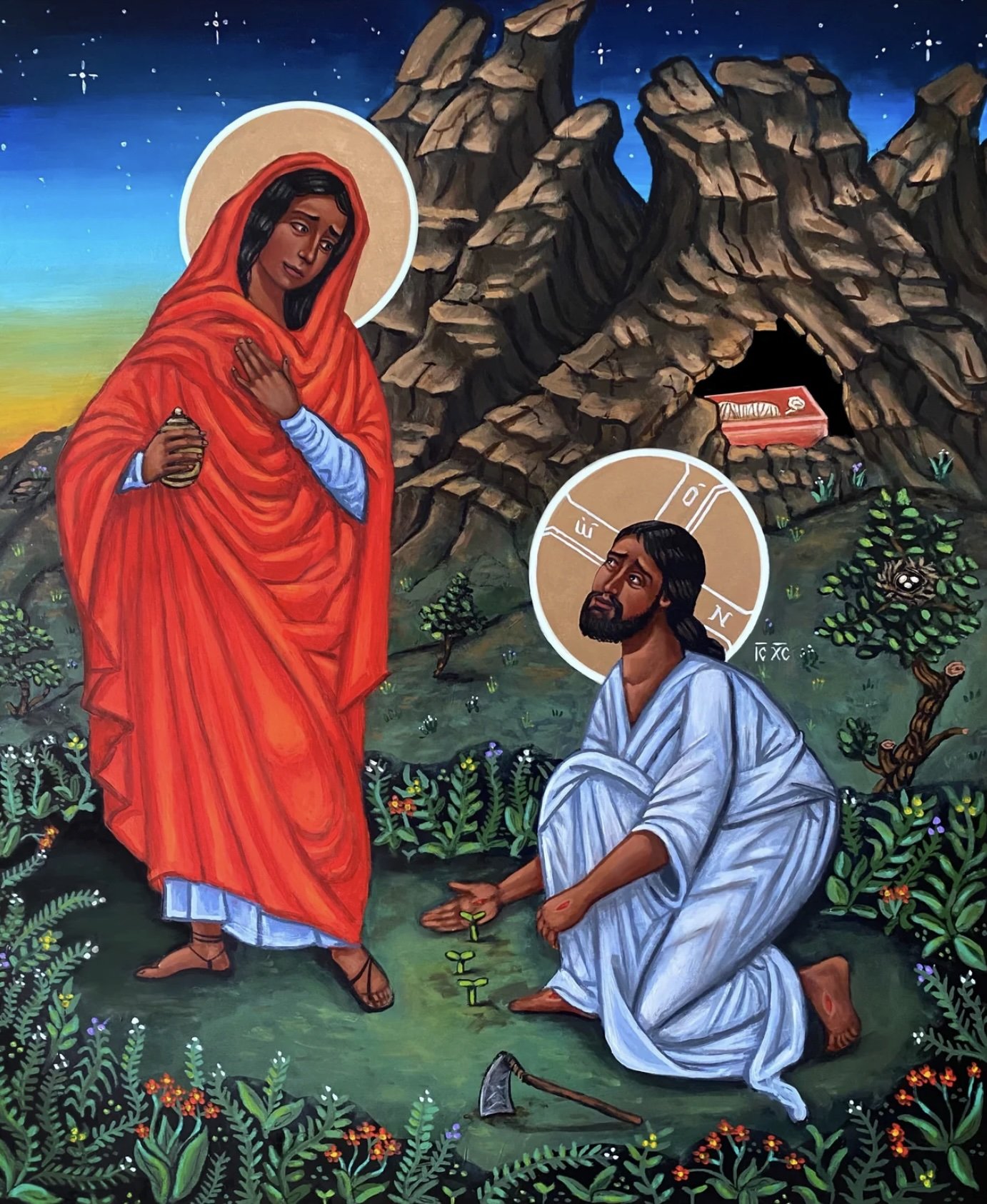
John 20:1-18
Early on the first day of the week, while it was still dark, Mary Magdalene came to the tomb and saw that the stone had been removed from the tomb. So she ran and went to Simon Peter and the other disciple, the one whom Jesus loved, and said to them, “They have taken the Lord out of the tomb, and we do not know where they have laid him.” Then Peter and the other disciple set out and went toward the tomb. The two were running together, but the other disciple outran Peter and reached the tomb first. He bent down to look in and saw the linen wrappings lying there, but he did not go in. Then Simon Peter came, following him, and went into the tomb. He saw the linen wrappings lying there, and the cloth that had been on Jesus’s head, not lying with the linen wrappings but rolled up in a place by itself. Then the other disciple, who reached the tomb first, also went in, and he saw and believed, for as yet they did not understand the scripture, that he must rise from the dead. Then the disciples returned to their homes.
But Mary stood weeping outside the tomb. As she wept, she bent over to look into the tomb, and she saw two angels in white sitting where the body of Jesus had been lying, one at the head and the other at the feet. They said to her, “Woman, why are you weeping?” She said to them, “They have taken away my Lord, and I do not know where they have laid him.” When she had said this, she turned around and saw Jesus standing there, but she did not know that it was Jesus. Jesus said to her, “Woman, why are you weeping? Whom are you looking for?” Supposing him to be the gardener, she said to him, “Sir, if you have carried him away, tell me where you have laid him, and I will take him away.” Jesus said to her, “Mary!” She turned and said to him in Hebrew, “Rabbouni!” (which means Teacher). Jesus said to her, “Do not touch me, because I have not yet ascended to the Father. But go to my brothers and say to them, ‘I am ascending to my Father and your Father, to my God and your God.’ ” Mary Magdalene went and announced to the disciples, “I have seen the Lord,” and she told them that he had said these things to her.
There’s a saying, derived from a couplet by the Greek poet Dino Christianopoulos, that goes something like, They tried to bury us, but they didn’t know we were seeds. It seems to resurface every couple decades or so, not surprisingly in times of strife. It’s a phrase about persistence, defiance, not giving in.
Last week, for Palm Sunday, we read Psalm 118, in which the psalmist writes of emerging from a battle, a time of oppression being surrounded by enemies on all sides, but with God on his side, he writes in verse 18, I shall not die, but I shall live. It’s a subversion of the human condition, one in which we are born to die, but the psalmist refuses that. He avoids certain death, in order to live to continue the work of spreading God’s good news of love, and to live in the strength and love and grace he is given by God. And in the latter half of the psalm, our psalmist sings for joy, celebrating overcoming adversity and violence thanks to his faith, shouting that this is the day God has made, and let us rejoice and be glad in it!
And today, we have the ultimate example of this. We have Jesus, not just avoiding death, but defying death, destroying death. Jesus died, actually died, but now lives.
He comes upon his dear friend weeping for him in the garden. Woman, why are you weeping? And then, Mary supposes him to be the gardener. Something is different. Sure, we could assume that maybe Mary couldn’t see clearly through her tears; or that maybe since no one would expect to see a risen Christ, her brain initially just didn’t compute… but this is not the only instance in the Bible in which Jesus isn’t recognized by those close to him after his resurrection—in Luke, on the road to Emmaus, Jesus walks alongside some of his closest disciples, he engages in conversation with them, but they don’t know it’s him. Something was different. Jesus was back, but after all that he had been through, he was not what he was before. But he was still Jesus—because it’s when Mary hears his gentle voice saying her name—Mary!—he who always saw and knew and loved her, she realizes Christ has risen, indeed. I imagine her eyes widening, I imagine more tears falling, transformed into tears of joy. Jesus is back. He is changed, he is different than what he once was, but his voice tells Mary that it is fully him, in the flesh, once again. They tried to bury him, but he rose up. He shall not die, but he shall live.
In Lauren Markham’s long-form essay Immemorial, which is about her climate anxiety and grief, especially in the wake of the birth of her daughter, she looks for ways people are dealing with this grief, these immeasurable losses. At one point, she stumbles upon this project that sits at the intersection of art and science, a collection of artists, biologists, and paleogeneticists. For this project, they took
DNA extracted from samples of extinct flowers and compared it to the genetic sequences of flowers that still grew on Earth, focusing on the species’ olfactory profiles. In so doing, they were able to approximate the scents of the extinct flowers—resurrecting them, essentially, from the dead.
This project is called Resurrecting the Sublime. Once they’ve perfected the scent, they set up human-sized dioramas, where people can see photos of the flower’s former habitat and be misted with the scent. “The fragrance,” writes Markham, “though based on science, was only an approximation.” One of the founders of the Resurrecting the Sublime, Alexandra Daisy Ginsberg, notes that “we end up with…a blurry picture of the past, a false yet powerful memory.” These fragrances cannot be the same after death. But they are still powerful, they are still once and of this earth.
Jesus was different after he rose. We know he rose with wounds from the cross that the disciple Thomas would later demand to touch for tangible proof. We know he was unrecognizable by sight, for reasons unexplained, for reasons we can only speculate. We know that his friends were met with someone changed, different, risen.
We are all changed—renewed for better and for worse—after the difficult seasons of our lives. Sometimes we are hurt and we shrink back, smaller than before, for a time, at least. Sometimes we put walls up, we push people away, refusing to every be hurt like that again. And sometimes, hopefully, eventually, with our faith in this power of resurrection that is the cornerstone of our faith, we come out stronger and ready for what comes next. And in this way, we are unrecognizable. We emerge a different person than we once were. They tried to bury us, but they didn’t know we were seeds.
At our home, we can only have succulents as houseplants, because our cats will kill any other plant; even some leafier succulents aren’t safe. And when one of our succulents is on its last breath, its last leaf, we try to save it. We take a leaf, we plant it, we propagate the best we can. What rises from that leaf is not identical to where it came from. It changes into a new plant, a new life, with the right sun, with the right care, with the right protection from our feline friends.
In describing what they hope their project Resurrecting the Sublime will inspire in people, the founders write,
This is not de-extinction. Instead, biotechnology, smell, and reconstructed landscapes allow us to once again experience a flower blooming on a forested volcanic slope, in the shadow of a mountain, or on a wild riverbank, revealing the interplay of species and places that no longer exist. Resurrecting the Sublime asks us to contemplate our actions, and potentially change them for the future.
When Jesus rises from the dead, he is different. And all those who witnessed his death, his loyal disciples, curious city and townsfolk, his worst enemies alike, are then forced to think about how they got here. How did this world become this way? And how did our own actions, our own conscious or unconscious complicity lead to the death of Jesus, this gentle savior? And now, how do we properly celebrate this miracle of new life? And how do we recognize the changed and risen Jesus in our world today?
Just like Mary, when we are overwhelmed with grief, anxiety, despair, it will be hard to recognize Jesus in our midst. It will be hard to recognize the Holy Spirit breathing through each and every person, hard to see the good in the world. Especially in a world of doomscrolling and algorithms specifically designed to feed off of rage and cynicism, designed to keep us from seeing the good in the world; and so Jesus gets lost. The Holy Spirit feels inaccessible. God feels absent. And the powerful want it that way. That’s why they hypnotize the masses with rage and AI, why they do everything in their power to keep the unjust status-quo. That’s why, in Jesus’ day, they killed him. They tried to bury him. But they didn’t know he was a seed. They didn’t know he would rise again and his message would propagate, proliferate, spread, spread, spread, until it could be silenced no longer.
Then, it was Mary. It was Mary Jesus trusted to make sure word got out. He could have surprised the beloved disciple and Peter. But it was Mary. Mary, who supposed he was the gardener. And she wasn’t wrong. Here was Jesus, garden and gardener, seed and wind, back to spread the good news of love and life with Mary’s help. In the beginning, it was up to Mary to tell people that this man is, indeed, Jesus; that the prophesies were true; that what Jesus had been saying all along had come to fruition, and maybe you won’t recognize him at first, but listen to that gentle voice amidst the clatter and the chaos and you will know. And you will finally, at long last, understand. Something is different about him, but listen to that gentle voice, and know and understand that this is Jesus, continuing to change the world.
And now, the task at hand is to continue to do just that—change ourselves, change the world. Change it into a people and a world that Jesus is begging us to usher in, the world that he died to make real, an earth as it is in heaven, a world and a people reborn and brand new—a world and a population that is unrecognizable to this one.
Christian mystic and theologian Dorothee Soelle writes,
To be reborn we have to die with Christ, which means that the old self is crucified with Christ…It is the old being: the egoistic, the self-concerned, the apolitical human being…the pious self, caught up in a form of spirituality that glorifies individualism…
The “old being” who must die is not only egocentric; she is also the powerless human being who feels incapable of changing anything in her world.
I wonder if that’s why it’s taking so long… I wonder if people are so afraid to rid themselves of that old being within, are afraid to make those selfless sacrifices… or perhaps the world has been so broken for so long they simply cannot imagine one in which endless war is no more, in which we truly love the stranger in our land, in which we truly love one another as Christ loves us. It seems impossible because the ultra-powerful and the uber-wealthy say it’s impossible, and so we resign ourselves to the only thing we’ve ever known. Because we can’t imagine what a world without all this hatred and violence would be like, and so we falsely believe we are powerless.
Truly, a world rising from the ashes of what we’ve destroyed would be unrecognizable. It would be so different, so changed from what we know and understand, we might balk at it initially; even the most well-intentioned and compassionate among us might be confused at first about what this new world would entail, might be hesitant to do what it takes to maintain a world without war or hunger or poverty. But I wonder… I wonder if we just listen for the voice of Jesus among us, if we just listen for that gentle nudging calling our names to this new world, if we might snap out of it—snap out of our algorithm-induced stupors, our rage-induced cynicism. I wonder if we just listen for the voice of Jesus among us today, if we might see what is really possible through the tears. And I wonder if we might finally realize that we are seeds— that no matter what happens to us or to this world, no matter what how dire things may seem, there is always the possibility, the probability, that we will persevere and find ourselves renewed, reborn, ready for an unrecognizable world, ready for something completely different, ready to be rid of all the violence and hatred and death. Because that’s what Jesus promises us in his resurrection.
And we are called to do everything in our power to follow through on that promise—and we do this by spreading Christ’s ultimate message of love, his new commandment: Just as I have loved you, you should also love one another. We do this by reminding ourselves and one another to really listen for Christ’s risen voice in the world around us. It’s unlikely that it will sound the way we expect. And it will be hard to recognize above the commotion and chaos that surrounds us. But it’s there. Risen. Never overcome. Christ never promised it would be easy (in fact, he says the exact opposite, a lot). But he promises us and shows us it is possible. He promises us and shows us what seems impossible is possible, shows us the possibility of world unrecognizable in its beauty. So may we go from this Easter Sunday, this Resurrection Sunday, practicing this persistent, unrelenting hope. And may we love and nurture this earth, and each other, so that we will always come back from our struggles stronger, wiser, and more loving. And may we always listen closely for that gentle voice calling each of our names— that surprising seed of unconditional love persisting, pushing, snapping us out of our complacency, and into the new world Christ ushers in. Amen.
