Marvelous
Psalm 118: 1-2, 19-29
O give thanks to the Lord, for he is good;
his steadfast love endures forever!Let Israel say,
“His steadfast love endures forever.”
Open to me the gates of righteousness,
that I may enter through them
and give thanks to the Lord.This is the gate of the Lord;
the righteous shall enter through it.I thank you that you have answered me
and have become my salvation.
The stone that the builders rejected
has become the chief cornerstone.
This is the Lord’s doing;
it is marvelous in our eyes.
This is the day that the Lord has made;
let us rejoice and be glad in it.
Save us, we beseech you, O Lord!
O Lord, we beseech you, give us success!Blessed is the one who comes in the name of the Lord.
We bless you from the house of the Lord.
The Lord is God,
and he has given us light.
Bind the festal procession with branches,
up to the horns of the altar.You are my God, and I will give thanks to you;
you are my God; I will extol you.O give thanks to the Lord, for he is good,
for his steadfast love endures forever.
Matthew 21:8-11
A very large crowd spread their cloaks on the road, and others cut branches from the trees and spread them on the road. The crowds that went ahead of him and that followed were shouting,
“Hosanna to the Son of David!
Blessed is the one who comes in the name of the Lord!
Hosanna in the highest heaven!”When he entered Jerusalem, the whole city was in turmoil, asking, “Who is this?” The crowds were saying, “This is the prophet Jesus from Nazareth in Galilee.”
Throughout this Lenten season, we’ve been exploring the Hebrew Bible texts in our lectionary, and we’ve been experiencing a seemingly endless cycle of sins, then consequences, then blessing and restoration. And today, we come to the psalm that was part of the inspiration for what we now know as Palm Sunday, for Jesus’ triumphant march into Jerusalem. Today, we come to a celebration— but in Jesus’ case, it is a celebration with a cloud hanging over it. The people are cheering this mysterious prophet with liturgies and chants, Hosanna, Blessed is the one who comes in the name of the Lord— they’ve been waiting to sing these chants to the chosen one, to the one who would come to save them; after all, Hosanna translates to save us.
From the psalm and the Gospel passage that Tom just read for us—the psalm being some kind of liturgical victory call-and-response, and in Matthew, the people cheering Jesus and laying down their cloaks for him and his humble donkey—you’d never know what lay ahead for Jesus… and as for the psalm, you’d also never know what great hardship leads up to where we really start in verse 19. What comes before our psalm for today is what makes our psalm even stronger in its utter euphoric joy. The writer says, “In my distress I called on the Lord; / the Lord answered me and set me in a broad place.” On the surface this doesn’t sound especially powerful, but as we talked about at Dinner Church on Wednesday, the power of this verse gets lost in translation— “distress,” from the Hebrew, quite literally means a narrow, confining, suffocating place; “a broad place” means a place of salvation, a place where we can finally breathe again. And this one verse sets the stage for the entire psalm—because as we continue, we have the writer lamenting that he was surrounded by enemies on every side, surrounding him like bees, blazing like a fire of thorns, but each time he finds himself in a similar predicament, God comes through and his faith is vindicated. After all the trials and battles, adversaries and oppressors, our psalmist finds themselves at the gates of righteousness, ready to greet the glory of the unexpected.
And he is ready because of all that he’s been through. He’s ready because, as it’s written in verse 17 and 18, “I shall not die, but I shall live… [and God] did not give me other to death.”
I shall not die, but I shall live. As Jesus marches through the city he knows that he will be given over to death… and yet he will not die, but he will live.
I’m always wary of preaching about the value of suffering, or the good that can come from it (and just a quick apology to Dinner Church folks who will have head a less-polished version of this already), because when people are really deep in their suffering, it’s the last thing the want to hear. But I do believe, once we are a little further removed from those difficult times, once we have worked through traumas, we are made stronger, wiser, more empathetic, once we come out the other side. And I also believe we are able to see things differently, able to have new perspectives and outlooks on life; able to see what others are not able to see. The stone that the builders rejected / has become the chief cornerstone. / This is [God’s] doing; / it is marvelous in our eyes.
In Sheila Heti’s strange and beautiful novel Pure Colour, the narrator muses about being middle-aged, and how her years and life experience are slowly but surely changing how she sees the world. Long gone are the days of trying to be cool and hip—she writes that when you become blind to all things cool and hip, God opens your eyes to everything else. “So don’t go chasing your old forms of sight,” she says, “Instead, learn to see newly. Right now it may feel like a loss of sight, or like you don’t understand the things you do see, but there is a lot to see here.” [i]
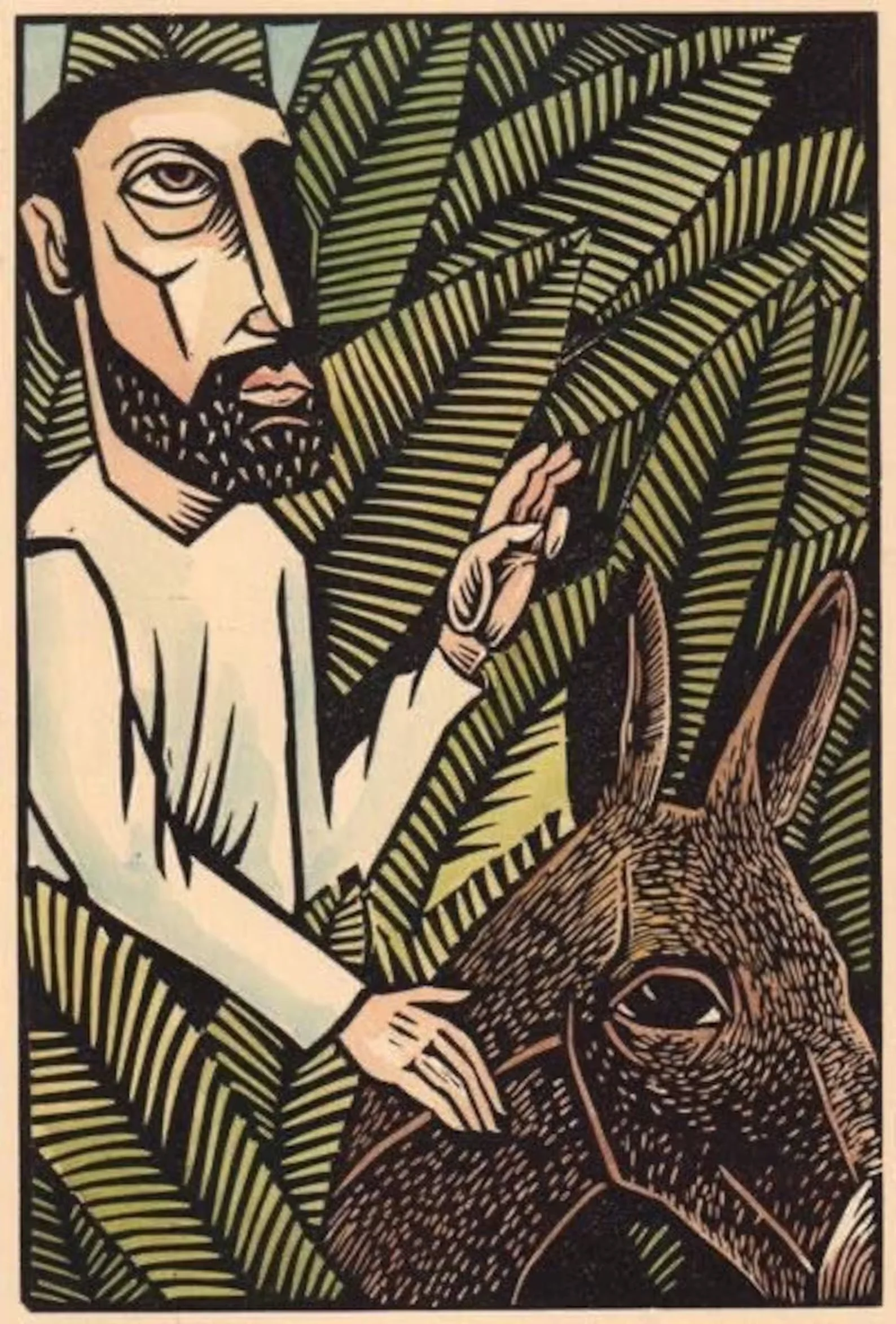
As we go through life, as we work to understand ourselves and others, as we work to grow in our faith, we realize what really matters, and we see glory in the most unexpected of places. The stone that the builders rejected /has become the chief cornerstone / it is marvelous in our eyes. Jesus marched into Jerusalem, play-acting a royal march—but doing so on a humble donkey, surrounded by his disciples and poor townsfolk—many of whom did not understand what was happening: "This is the prophet Jesus from Nazareth in Galilee," the crowd cries, correctly seeing him as a prophet, but not understand that he is so much more… and yet. Something about him, about this strange and humble procession is marvelous in their eyes. Something about this prophet, subverting what his society thinks of a royal procession, by bringing it down to earth, on a donkey, with normal people, something about this strange sight that would be scoffed at my so many is marvelous in their eyes.
In verse 9 of our Psalm, our psalmist writes, “It is better to take refuge in [God] / than to put confidence in princes.” And so here is Jesus, God in human form, marching as the Prince of Peace, yes, but subverting all ideas about what a price is, about what a royal procession is. There is no chariot. There are no nobles. In spite of the crowds, there is little fanfare—no pyrotechnics, no royalty or celebrities from the Roman cult. This procession is a new way of seeing royalty, and a new way of seeing God. In this moment, we see God, Jesus, humble on a donkey, peasants laying cloaks and branches at his feet. They’ve been waiting all this time, decades, generations, centuries, to enact Psalm 118 for the coming savior, and when they do, it’s surely not what they thought it would be… and yet: “The stone that the builders rejected / has become the chief cornerstone.”
This procession was never going to be what was expected. This coming of the savior was never going to be some kind of bombastic king ruling with an iron fist. It was always going to be something that made no sense. It was always going to be something that turned the world on its head, made everyone think differently, see newly. It was always going to usher in a new era, in which people rethink what is right and wrong, in which people understand that it’s not golden chariots or monuments or domination that makes a king, that makes a savior… it was always going to usher In something brand new.
But when something brand new is ushered in, there will always be backlash. When someone goes against the grain and challenges authority, challenges empire, there will always be those in power who will do anything to stop it in its tracks. The Roman Empire was against any emphasis on humility or humanity because that challenged its own show of power and force, and therefore challenged its complete oppressive control over its people. Jesus made people see newly—he made them see what God can be, what God truly is, and what a better world could be like—a world that no longer prioritizes wealth and domineering power, but rather compassion and love, and being one with the people.
Surely seeing a prophet, a savior who deigns to truly walk among the people was shocking, but surely it was also a breath of fresh air—a preview of life “in a broad” place, no longer under the suffocating grip of empire. But it was just that— a preview. It was a fleeting moment in which the people could, for just a little while, breath freely and feel what it would be to live in a world that rewards humility over arrogance, humbleness over dominance, love over hate. As Episcopal priest Rev. Andrew Thayer wrote last year in an op-ed about Palm Sunday, “[people] often miss an uncomfortable truth about Jesus’ procession: At the time, it was a deliberate act of theological and political confrontation. It wasn’t just pageantry; it was protest.”[ii]
There’s a lot of discourse about whether or not the No Kings protests like the ones organized yesterday make any difference. The cynical, of course, will scoff and say no. But gathering together and feeling that solidarity, gathering together, and feeling less alone during this time of chaos and war. It’s a time to be fortified and lifted up by others, and to fortify and lift up in return. It’s a reminder that together, we are powerful, loving, and joyful.
Will a single protest bring about world peace? No. But they are organized to show that there are people who won’t stand for brutality towards immigrants, or needless, endless war; they happen so that we may be buoyed and keep going. They happen so we can show that we will not give up, so that we can proclaim, we shall not die, but we shall live.
When we read of Palm Sunday, in spite of the hymn of victory being sung, in spite of the joyful hosannas, we know what Jesus was really marching towards his death. But the celebration of Palm Sunday will always remain a reminder, a preview of a world without empire, a world with compassion and empathy, a way to see newly, to see what royalty should really look like. And next week, when we get to the resurrection, we’ll go even further and hear the glorious story of a world without death. I shall not die, but I shall live, our psalmist says. And it will be marvelous in our eyes. Amen.
[i] Sheila Heti, Pure Colour (New York, NY: Farrar, Straus and Giroux, 2022), 165.
[ii] https://www.nytimes.com/2025/04/13/opinion/palm-sunday-protest.html
