Emergence
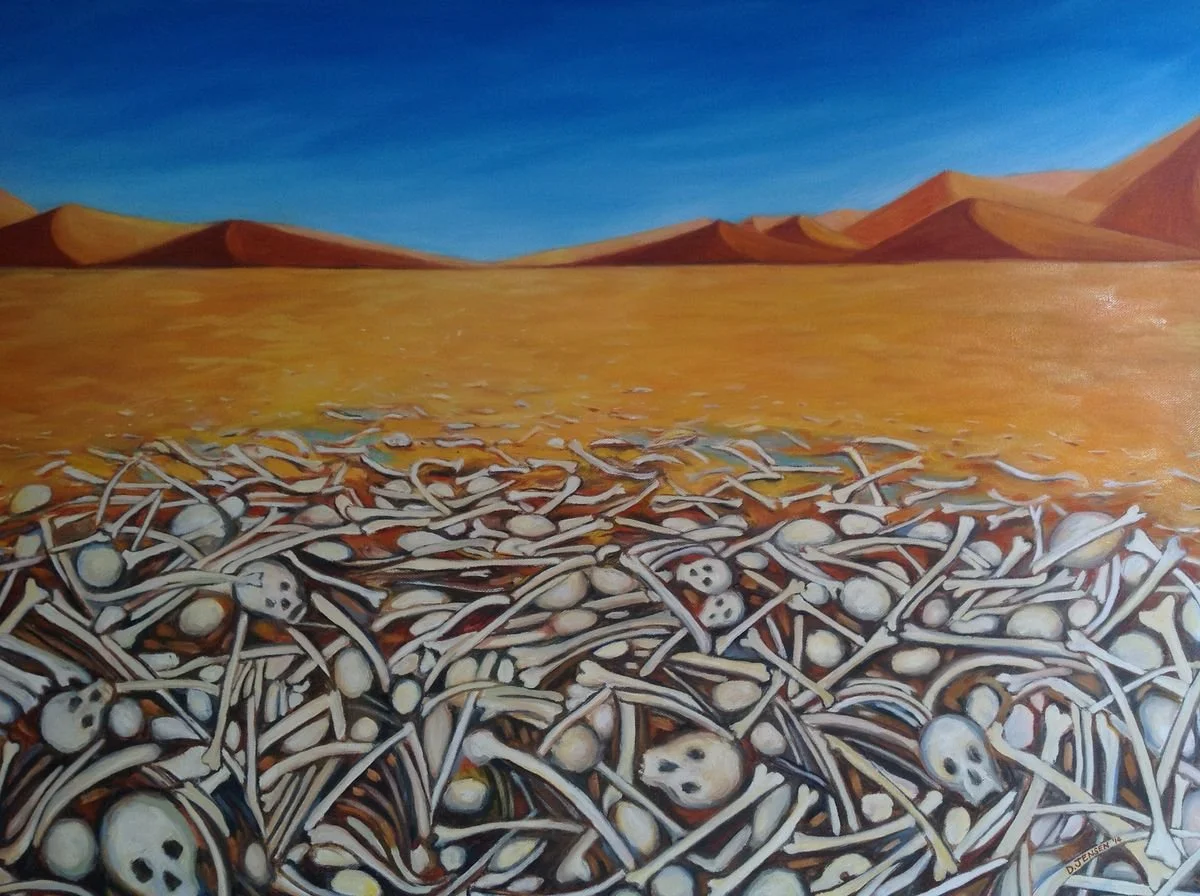
Ezekiel 37:1-14
The hand of the Lord came upon me, and he brought me out by the spirit of the Lord and set me down in the middle of a valley; it was full of bones. He led me all around them; there were very many lying in the valley, and they were very dry. He said to me, “Mortal, can these bones live?” I answered, “O Lord God, you know.” Then he said to me, “Prophesy to these bones and say to them: O dry bones, hear the word of the Lord. Thus says the Lord God to these bones: I will cause breath to enter you, and you shall live. I will lay sinews on you and will cause flesh to come upon you and cover you with skin and put breath in you, and you shall live, and you shall know that I am the Lord.”
So I prophesied as I had been commanded, and as I prophesied, suddenly there was a noise, a rattling, and the bones came together, bone to its bone. I looked, and there were sinews on them, and flesh had come upon them, and skin had covered them, but there was no breath in them. Then he said to me, “Prophesy to the breath, prophesy, mortal, and say to the breath: Thus says the Lord God: Come from the four winds, O breath, and breathe upon these slain, that they may live.” I prophesied as he commanded me, and the breath came into them, and they lived and stood on their feet, a vast multitude.
Then he said to me, “Mortal, these bones are the whole house of Israel. They say, ‘Our bones are dried up, and our hope is lost; we are cut off completely.’ Therefore prophesy and say to them: Thus says the Lord God: I am going to open your graves and bring you up from your graves, O my people, and I will bring you back to the land of Israel. And you shall know that I am the Lordwhen I open your graves and bring you up from your graves, O my people. I will put my spirit within you, and you shall live, and I will place you on your own soil; then you shall know that I, the Lord, have spoken and will act, says the Lord.”
We don’t read much Ezekiel throughout the church year. It doesn’t show up a ton in the lectionary. Probably because many of Ezekiel’s writings are, like this one, strange, macabre, off-putting. The prophet Ezekiel wrote in the time of the Babylonian exile. He was a well-regarded and respected priest and prophet, very sophisticated and educated—but he was also… very intense. Some believe he was mentally ill. Some believe he suffered from PTSD, having witnessed so much violence and war. He often found himself in trance-like states, seeing extraordinary visions… but whatever he was, he left us with some of the strangest, most troubling, and confounding texts in the Bible. Our scripture today is like something out of a horror movie—reanimated skeletons being lifted from the ground, sinew and muscle and flesh reappearing.
In this passage, “multitude” could also be translated to army, so we’re meant to picture a former battlefield, here—something Ezekiel would have been tragically familiar with, living in this time of oppression, exile, and war. It brought to mind a visit I had a few years ago to Gettysburg with my friend. As we explored the battlegrounds, plaques encouraged us to imagine the vast fields in front of us strewn with thousands of bodies, injured and dead, in the aftermath of the bloodiest battle in American military history. But in our story today, the battlefield is an old one. The flesh and decayed and decomposed, returned back to the dry dust from which he emerged; only the bones are left, a remnant of a forgotten battle, a remnant of a despairing and discouraged people.
“Can these bones live?” asks God. Ezekiel, troubled though he may have been, was never lacking faith. Knowing that anything is possible with God, he refuses a definitive answer, replying, “O God, you know.” And so Ezekiel with the breath of God, breathes flesh onto bones, breathes oxygen into lungs, and these dry bones come together again, to make a whole person, a whole people, a prophesy of a people rising from the ashes.
You could say that Ezekiel was something of a zealot. He believed that the exile his people were experiencing was well-earned. Beginning in chapter 8, God shows Ezekiel in visions desecration of the temple— he sees idol worship, he sees rituals that go against their own. He sees paintings and statues of Gods of other traditions. And finally, God shows Ezekiel priests actively worshipping the Mesopotamian sun god, in the temple and then cries, “Is it not bad enough that the house of Judah commits the abominations done here? Must they fill the hand with violence and provoke my anger still?” And so Ezekiel was shown that his people have given up on their faith, and have fallen to the temptations of violence and domination of their enemies. And so Ezekiel believes he and his people deserve Nebuchadnezzar’s destruction that comes upon them and the exile they’ve been forced into.
In the book of Ezekiel, there are many direct conversations with God, and God acts directly upon the people, Ezekiel believing Nebuchadnezzar is an instrument of God’s punishment. I’ve said before, I could never believe that an all-loving God would actively punish us. But I do believe that he we need to learn from our history, from our past sins, and if we can’t, we will indeed bring destruction onto ourselves. Must they fill the land with violence? asks an angry and despairing God. I have to imagine God is asking similar questions now. When will we learn from our sins of violence and imperialist aggression? When will be learn from our sins falling for the temptations of greed and abhorrent wealth? When will we learn? What must happen for us to learn? How divided and fractured and hyper-individualistic and disconnected must we become before we realize we have to come together as one to make this world a just and peaceful place? How far will we fall before we learn?
Now, Ezekiel’s dry bones didn’t come out of nowhere. Provers 22:17 reads, “A cheerful heart is a good medicine, / but a downcast spirit dries up the bones.” One with dry bones was one who was discouraged, depressed, despairing. It essentially meant you had given up. So for our passage today, Ezekiel’s vision takes this metaphor and transforms it into something literal. His vision sees the dried bones of corpses scattered and then coming together, and no longer dried— mended, connected, and moistened with new life. It’s a vision of a people restored.
In Bible Study on Monday, Rob noticed that one the recurring themes throughout these Lenten Hebrew Bible readings was kind of an endless cycle of messing up, experiencing the consequences of messing up, and being forgiven— and I had just written in my sermon notes, a seemingly endless cycle of punishment and death and then restoration. It’s exhausting. It was exhausting then. It’s exhausting now.
I was skimming the news, as I do these days—enough to remain informed, but I try to stop before I get too depressed—and I came upon a New York Times article that interviewed a dozen or so gen Z men and women, recent college grads mostly, about the current job market, how bleak it is, how discouraged they are. And it was shocking to me how familiar it all sounded. Aside from some tech “advances,” like the looming specter of AI, it was virtually the same situation that I experienced when I graduated from college in 2009—entry-level positions requiring at least five years of experience, salaries and hourly wages barely covering the cost of rent, the similarities were troubling. A week before, as the war and violence in Iran continued to escalate, I saw meme after meme about how with illegitimate war in the middle east and low-rise jeans being back in fashion, it feels just like 2002 again. It drove me into a bit of a spiral for a bit. I realized how prescient these scripture passages we’ve been reading truly are— because we really never learn. We never learn that we need to give people the tools and support to start good and comfortable lives. We never learn that we don’t get peace or justice by indiscriminate bombing. We never learn that we don’t get any kind of upward economic mobility or equity by giving tax breaks to the ultra-rich. We just never learn.
And so maybe I agree with Ezekiel—that we deserve all we are receiving. I don’t agree that God is actively pulling strings to make this world a difficult place to live, no, but I do believe that if we choose to disregard the mistakes of the past, we will remain in this vicious, brutal cycle. And when I say we, please know I’m not blaming this congregation in rural Vermont for going to war and Iran and for a rough job market. I say we as in humankind, as a people. A major reason these cycles seem to continue, seemingly in increasingly rapid succession, is because of how divided we all our, how deeply disconnected we are from one another.
If the passage of the dry bones is familiar to you for any other reason aside from knowing it from the Bible, it’s probably for the Black spiritual Dem Bones, in which the verses read “Toe bone connected to the foot bone / Foot bone connected to the heel bone / Heel bone connected to the ankle bone / Ankle bone connected to the leg bone…” and so on and so on… And I think that’s what the writers of this spiritual, the brothers James Weldon and J. Rosamond Johnson, get so right—that it’s all about connection. It’s all about coming together, coming back together.
Ezekiel’s people were scattered. They were forced apart, into new and different lands, and it would take some serious work to come together again. But Ezekiel had a vision that it would happen—a vision in which they were guided back together by the breath of God. In the final chapters of his book, Ezekiel describes in exacting detail the utopia this new promised land will truly be.
Now, we are not physically scattered from one another, no. But we are politically, spiritually, emotionally, and I sometimes wonder if that’s even worse—we are the way we are now, completely by our own design. We can connect with anyone we want by pressing a button, and yet we choose to isolate ourselves in echo chambers, refusing to listen to one another. The people in power refuse to hear or even speak the truth, and regular folks refuse to truly hear or speak to each other. And so we find ourselves in a valley of dry bones of our own making.
It’s connection that will make us whole again. Ezekiel and his people longed for the day when they would be back together as one people, in one place, and God provided Ezekiel with a wild vision showing him it would happen, showing him that anything in possible when we keep our faith, and when we recognize our wrongs; and so, despite the deplorable ways they had been acting, despite what brought them into exile in the first place, Ezekiel saw a vision of his people rising from the depths of despair. And then Ezekiel saw a time in which this endless cycle of sin and fall and restoration would finally come to an end.
When this cycle will come to an end, I can’t tell you. But we can hold onto our faith that tells us that God blesses above all else; that God can breathe new life into the dryest and dustiest and most depressing valleys of our lives. And with that faith, we can be buoyed and encouraged to rise from the depths and connect with each other again, to connect with the world around us, to really be present and work to understand why we keep ending up in these vicious cycles. Now, realistically, we, here in small town Vermont, are not going to be able to convince those who are unilaterally deciding to go to, yet again, restart an illegitimate war in the Middle East—that is, unfortunately one imperialist cycle we cannot single-handedly fix… but we can find other, smaller ways to quench our thirst for justice, to moisten our own dry bones. We chose to come here, on this depressingly wintry morning, knowing that connecting with each other, even for this hour, would bring us something, would inspire us to keep going in this chaotic mess of a world. Little by little, we can work to break vicious cycles of despair and disconnection with every choice we make—every choice to connect back with nature when we go for a quiet walk in the woods, and see new life springing up around us; every time we make the choice to forgive someone who we feel has wronged us in some small way; every time we make an effort to hear someone from outside our own echo chambers of outrage and anxiety. Because of how quickly the world has changed, is changing, these small choices can take effort and planning. These small choices take faith that in spite of all that is going on around us, in spite of the onslaught of bad news, in spite of the depressing feelings of déjà vu, that we can rise up and break free from this exile of our own making, that we can help to usher in a better world.
At the beginning of Rebecca Solnit’s book A Paradise Built in Hell, about communities and social movements that rose our of disasters, she writes,
The word emergency comes from emerge, to rise out of, the opposite of merge, which comes from mergere, to be within or under a liquid, immersed, submerged. An emergency is a separation from the familiar, a sudden emergence into a new atmosphere, one that often demands we ourselves rise to the occasion.
In a world as overwhelming and chaotic as ours can feel today, as ours is today, there is always some kind of horrible breaking news pinging on our phones—we have myriad opportunities to emerge from below into something new and good. So instead of allowing those emergencies to paralyze, allow them to motivate. Allow them to shake us free of our exiles of our own making, of our isolation from our fellow human. Allow yourselves to emerge from the depths to something new and unfamiliar. And then, at long last, as a people, may we come together, and be made whole again. Amen.
