Spring
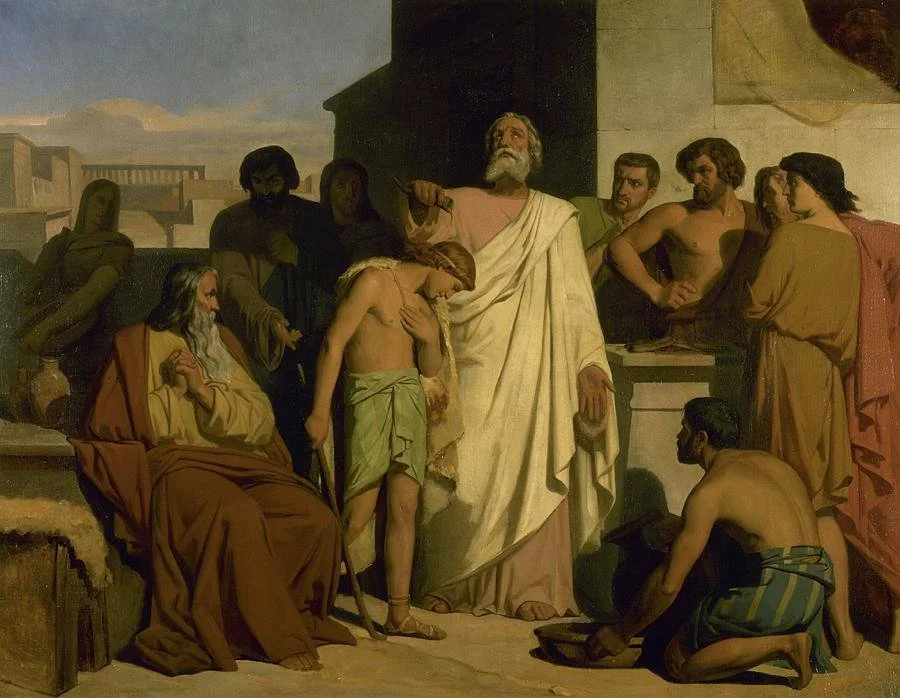
1 Samuel 16:1-13
The Lord said to Samuel, “How long will you grieve over Saul? I have rejected him from being king over Israel. Fill your horn with oil and set out; I will send you to Jesse the Bethlehemite, for I have provided for myself a king among his sons.” Samuel said, “How can I go? If Saul hears of it, he will kill me.” And the Lord said, “Take a heifer with you and say, ‘I have come to sacrifice to the Lord.’ Invite Jesse to the sacrifice, and I will show you what you shall do, and you shall anoint for me the one whom I name to you.” Samuel did what the Lord commanded and came to Bethlehem. The elders of the city came to meet him trembling and said, “Do you come peaceably?” He said, “Peaceably. I have come to sacrifice to the Lord; sanctify yourselves and come with me to the sacrifice.” And he sanctified Jesse and his sons and invited them to the sacrifice.
When they came, he looked on Eliab and thought, “Surely his anointed is now before the Lord.” But the Lord said to Samuel, “Do not look on his appearance or on the height of his stature, because I have rejected him, for the Lord does not see as mortals see; they look on the outward appearance, but the Lord looks on the heart.” Then Jesse called Abinadab and made him pass before Samuel. He said, “Neither has the Lord chosen this one.” Then Jesse made Shammah pass by. And he said, “Neither has the Lord chosen this one.” Jesse made seven of his sons pass before Samuel, and Samuel said to Jesse, “The Lord has not chosen any of these.” Samuel said to Jesse, “Are all your sons here?” And he said, “There remains yet the youngest, but he is keeping the sheep.” And Samuel said to Jesse, “Send and bring him, for we will not sit down until he comes here.” He sent and brought him in. Now he was ruddy and had beautiful eyes and was handsome. The Lord said, “Rise and anoint him, for this is the one.” Then Samuel took the horn of oil and anointed him in the presence of his brothers, and the spirit of the Lord came mightily upon David from that day forward. Samuel then set out and went to Ramah.
I’ve talked before about how we, in low church, mainline Protestant traditions a lot of traditions in the liturgical calendar seem to fall by the wayside. I’ve spoken to folks in this congregation who grew up in the UCC who never did much during the season of Lent—no Ash Wednesday services, etc. So it shouldn’t have been a surprise to me that today is a special Sunday, and one that I wasn’t aware of until I was doing my research for this sermon… it’s Laetare Sunday. Laetare is the Latin imperative for rejoice! A little odd, you might be thinking—after all, Lent is a somber time for repentance, for discernment, for recognizing that yes, we are making our way to the resurrection, but before we get to that, we are making out way to the cross. But that was just the point of Laetare Sunday— it was to give people encouragement to continue on that journey, and as the tradition evolved, it began to be mostly geared towards kids. I can imagine, especially a hundred or two-hundred years ago, when the church was a little stricter, a little more intense, perhaps, that kids got pretty cranky, pretty sick of fasting or whatever else was required of them… it’s no wonder that kids, and probably the adults alike needed a little pick-me-up during this halfway point.
I was really intrigued by this idea of Laetare Sunday, but on the surface, our passage today doesn’t seem especially joyful. It even starts with our prophet Samuel grieving, and God essentially telling him to snap out of it. With that said, we’re once again plopped in the middle of a complicated narrative, and we need some background and some context here. While Samuel has two books named after him in the Bible, and is indeed very important; and while Samuel is, of course, a common threat throughout these books, the books aren’t about him, per se. First and Second Samuel are really about the transition from a scattered, decentralized government of tribes led by judges (hence the name of a previous book of the Old Testament, Judges), to a monarchy (hence the books after Samuel—1 and 2 Kings). Samuel is called by God to anoint kings in this transition. And where we are now, is that Saul was anointed by Samuel, on God’s command, as Israel’s first king. Unfortunately, his reign is not going well. Saul was tall and handsome, he looked the part of a leader… but in the end, he wasn’t fit for power. He begins to grow rash, impatient, and arrogant. He disobeys Samuel’s and therefore God’s orders, and immediately before our passage today, it is written, “…and the Lord was sorry he had made Saul king of Israel.”
So today, God tells Samuel, get over it, go find our new king. Samuel is grieving because he’s been something of a mentor to Saul (I couldn’t help but think about Star Wars, about Obi-Wan and Darth Vader when I was reading this—a wise and sage mentor who can’t stop his beloved from turning to the dark side), surely he’s wondering what he could have done differently to stop this from happening… but God calls, and Samuel must be on his way to this a new king. And God is putting Samuel in a precarious position here—Samuel’s essentially being instructed to commit treason. But Samuel, dutiful messenger and prophet, obeys.
The danger of this is not lost on the people he visits either— when he finds Jesse and the elders of Bethlehem, it’s written that the elders “came to meet him trembling.” They know whatever reason Samuel is visiting cannot be good—either he’s coming on Saul’s behalf, and the unstable Saul is angry at them for whatever reason… or he’s here against Saul, which would in turn make them conspirators. It’s really a lose-lose situation for them. But regardless, Samuel makes it clear he comes “peaceably.”
This Lent, we’ve been racing through the Hebrew Bible, from the Garden, to next week, when we’ll find ourselves with the troubled prophet Ezekiel— if one didn’t think too deeply, you might think the scholars who chose these stories did so at random; but there are clear themes throughout. In each story, we find blessings in disguise, we find people of extraordinary faith and conviction, and we see God doing brand new things. And we find an evolving God—a God that changes their mind, a God that rights wrongs, a God that no longer punishes, but instead blesses. And God chooses and blesses the unexpected. And even in the midst of turmoil, of chaotic, arrogant, and rash leadership; in times of disappointment and deep grief, there is reason to rejoice. There is reason to hope for the future.
Our passage today ends with an intimate, really a secret ceremony of anointing. But David will not immediately become king. First, he will sneak his way into Saul’s court by playing his beautiful music; then of course, he will defeat the giant Philistine Goliath. And Saul will continue his downward spiral into arrogance and madness and die by his own sword. It’s a lot to get through… but the anointing of a small, unknown, seemingly insignificant shepherd boy is a promise from God that better days are on the horizon. It is a promise that before long, there will be reason to celebrate.
Maybe it’s hard for us to connect to this idea of celebration, of rejoicing— in the middle of Lent, as well is in the midst of everything going on in the world— violence here (the synagogue that was attacked on Thursday in Michigan was a few miles away from my good friend’s family’s synagogue, and I spent an hour worried it had been the one he grew up in—he was obviously shaken nonetheless), plus illegal and needless war abroad. I get it. I’m there too. And it was surely hard to Samuel and his people too. Here was Samuel, grieving his relationship with Saul, and surely worried about his people’s future, as their first try at this new form of government wasn’t going well. There were constant battles and skirmishes, a complete lack of certainly or stability. And though Samuel was doing right by God, going where he was told, anointing who he was told to anoint, he’s clearly uneasy about this whole thing. Between his grief and his anxiety, it seems that he can’t quite see what this will all look like at the end. And in fact… he doesn’t even get to find out. Samuel will die before David is crowned king.
In her new book, The Beginning that Comes After the End, Rebecca Solnit writes of all the who came before us to fight for a better world, who made it up as they went a long, who trusted and believed that things could be better—and she says,
This is a reminder that you do not have to picture the destination to reach it or at least draw closer to it, you just need to choose a direction and keep on walking—though that metaphor makes it sound as though it already exists, if at a distance, rather than that the process itself creates it and covers the distance between the idea and the actuality.
In our journeying and our crooked paths to this new future, we are creating it. We don’t know what is ahead, because it hasn’t happened yet. We can’t see the future. But we’re doing our best to make sure whatever ends up being ahead is a better world than the one we have now.
Yesterday, I woke up and saw a blanket of snow in the ground, and though it looked beautiful, and though I know all too well that in New England, mild weather doesn’t really come until late May, I still found myself feeling that seasonal depression that, for me, happens in March and April as opposed to deep winter— and I think that’s a pretty common thing in Northern New England. But we know in spite of these late winter snowfalls, Spring does come. Solnit quotes poet Pablo Neruda in her book, “You can cut down the flowers, but you can’t stop the spring.” Just like we know all too well that no matter how cold and gray and gloomy things seem, the gentle Spring weather will, at long last, arrive. We in this region of the country are more aware of that than most. And this very fact of life and of nature to religious life, to political life, to life in community. There will always be those clinging to the old ways, there will always be those grieving the past, afraid to venture into the future. There will always be some semblance of the old guard clinging to power by any means necessary. But what is good and right cannot be stopped. Slowed down, weakened, along the way, sure… but not stopped.
It’s hard to hold strong to our faith, to the promise of a brighter future when things seems so dire. It’s hard to imagine a time when we will, as an entire people, rejoice again. But it’s not for us to see the future, and it’s not for us to understand exactly how we get there; it is for us to work to get there regardless. It is for us the emulate the paths of the prophets who came before us and trust in God’s call—the unquestioning faith of Abram, the frustrated but persevering Moses, the grieving and uncertain, but ultimately faithful Samuel; and of course, the sacrificial and divine path of Christ. We can’t pretend to understand God’s ways, but we answer the call of Christ because of the promised outcome of equity and love for all. Even Christ, knowing what awaited him, while in the garden, pleaded with God, “…if you are willing, remove this cup from me, yet not my will but yours be done.” He was scared, but he knew what God’s will being done would mean. He would be cut down for a time, yes, but you cannot stop the Spring.
The end result may seem impossibly far away right now, and realistically, it may be impossibly far away for most of us. We will likely not see paradise, an earth as it is in heaven, in our lifetimes. Even as that promised Spring inches its way forward, there will be rights to wrong, reparations to make, sins to forgive and to repent for, for decades, for centuries. But that is the journey, after all. That’s why we observe Lent every year—to remind us that the path is arduous, that the path requires deep discernment and reflection. It is both a reminder and a promise—the path and dangerous and scary, but the reward is great.
Will we truly see the reward in any of our lifetimes? Probably not. But on this Laetare Sunday, we are reminded of the unbelievable joy and love that awaits in that promised time—and we get what glimpses of it we can now. Here, in the middle of March, even on cold days, we can begin to feel the warmth of that sun breaking through. Yesterday, Frankie helped me to make a base of sticks in our garden bed to prep for what new life will arise from there this spring. Every time I thought she’d be ready to go in, she said, “Let’s get more sticks!” This is pure joy amidst the cold, last gasps of winter. Just as so much of what is happening in our world right now are the last gasps of a desperate an old guard, falling away. On this Laetare Sunday, it seems that there is little to celebrate, even from our scripture passage, full of uncertainty and political intrigue. But it’s all leading to joy—a change in leadership, by way of our continued evolution of our unconditionally loving God. But Samuel and his allies have to walk a precarious, even treasonous path first, trusting in God that it’s the right thing, trusting in God that it’s all worth it, even if they’re not the one who will reap the rewards of that new reign of the future King David.
In her book, Sonit quotes a speech from author Arundhati Roy: “Another world is not only possible, she’s on her way. Maybe many of us won’t be here to greet her, but on a quiet day, if I listen very carefully, I can hear her breathing.”
Yes, Lent is a solemn time for reflection and repentance. But that reflection and repentance require a quiet discernment in which we don’t experience shame or punishment—but rather, one in which we experience joy and blessing. Samuel trusted in God’s plan, because he trusted in God’s promise, that God would never again destroy us. And so I would imagine that, in spite of his grief and his fear, Samuel felt some hope and some joy in this possibility he was being handed of a new and better future.
This Lent, may we all stop and listen for that new world quietly, but surely breathing on the horizon. And may we quietly rejoice. Amen.
