The Humanity of the Trinity
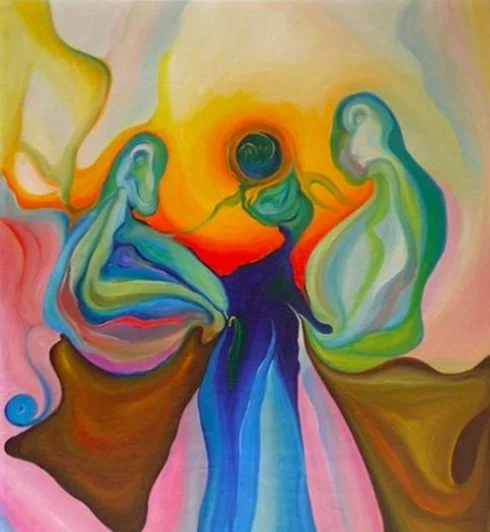
Matthew 28:16-20
Now the eleven disciples went to Galilee, to the mountain to which Jesus had directed them. When they saw him, they worshiped him, but they doubted. And Jesus came and said to them, “All authority in heaven and on earth has been given to me. Go therefore and make disciples of all nations, baptizing them in the name of the Father and of the Son and of the Holy Spirit and teaching them to obey everything that I have commanded you. And remember, I am with you always, to the end of the age.”
In his first encyclical, (an encyclical in the Catholic church is, essentially, the most important type of document a pope can write, a lesson, or guide for Catholic doctrine, concerning a certain issue) Pope Leo the XIV writes,
…human persons are called to communion with God and ‘can fully discover their true selves only in sincere self-giving.’ Indeed their deepest vocation is to enter into the Trinitarian dynamic of love received and shared.
How perfect for this Trinity Sunday, to have been given such beautiful and relevant words from the current pope. But it’s more than just relevant for Trinity Sunday—has anyone been following the news on this, anyone know what the encyclical is about? AI! Pope Leo chose to write his first encyclical about the many dangers of AI in relation to the Christian faith, in relation to a trinitarian theology, and also in the context of liberation theology and the ongoing work of social justice that we’re called to, as any kind of Christian, in the name of Jesus.
The trinity is probably the most difficult Christian theological concept to understand, much less explain. Theologians and philosophers alike have struggled to articulate what it means for centuries… after all, how can one being also be three? How can three beings be one? It’s truly a divine mystery. And when our passage that Tom just read for us was originally written, the doctrine of the trinity was not actually a thing yet. Some believe that verse 19, where Jesus instructs his disciples to baptize future believers in the name of God, the Son, and the Spirit was a later addition, even; but it’s more likely it simply had a different meaning than it does today— in that in the context of our passage today, “the Son” was just a descriptor for Jesus, it wasn’t some doctrinal decree, and the Holy Spirit, as we’ve been talking about here and there over the past few weeks was what we were given in Christ’s physical absence. “I will not leave you orphaned,” he says in John; and here, “I am with you always…” So as mystical and strange and paradoxical as it may be, I think we can understand how the trinity came to be—Jesus, of God, the Holy Spirit of Jesus, the promise of never being left alone despite Jesus’ physical absence; the fact of God, in the form of Jesus becoming one with us, in human flesh. It’s all one. So simple, but so wildly complicated at the same time. And it’s in this middle stage, in the humanity of Christ, (for me at least) that it all comes together.
Pope Leo seems to agree—he continues in his encyclical:
…we see [the] most concrete expression [of the mystery of God as love] in the face of Jesus Christ, the Incarnate Word. By becoming [hum]man, the Son of God enters our history and takes on human flesh, bringing with him the love that unites him to [God] and the Holy Spirit. In him, “the mystery of humanity truly becomes clear” because his humanity is completely free, open to others, capable of building healthy and beautiful relationships and committed to the total gift of self.
The pope’s encyclical is titled Magnifica Humanitas: Magnificent Humanity. Jesus became human to bridge the gap for the rest of humanity between God and the Spirit, to teach us how to be truly human in the world, to teach us to lead our brief, mortal lives with love and compassion, with real feeling and empathy with our fellow humans.
Our passage today has been coined “the Great Commission.” It’s the very last passage of the gospel of Matthew, and Jesus is about to ascend for good, or at least until “the end of the age,” and he gives his disciples simple commands: make disciples of all (Jews and Gentiles alike) who want this faith, baptize in the name of Creator, Christ, and Spirit, this proto-trinity, and teach the world everything I have commanded you. The key here, I think the last part. It’s likely a call back to Matthew 5, the Sermon on the Mount: Blessed are the poor, those who mourn, those who hunger and thirst, the merciful, the peacemakers… up until this point, Jesus was the sole teacher of all this. Now he is passing the baton to his beloveds to continue his ministry to all of humanity, to show humanity what is righteous and good, which is also to say, to follow in Jesus’ example as the ideal example of pure, unselfish humanity.
Just as last week’s passage seemed like a sudden pivot from the farewell discourses of John to the Pentecost passage of Acts, yet actually had a beautiful continuity in regard to the gift of the Holy Spirit, this week’s “great commission” is also a perfect follow-up to those farewell discourses. In John 17:11, Jesus prays to God, on behalf of his disciples, “…protect them in your name that you have given me, so they maybe be one, as we are one.” He wants the disciples to be so bonded, so connected, so devoted to one another, and to the rest of humanity, that they are as one in the same way God and Jesus, and the Spirit are one.
Now, some might be tempted to interpret this as an invitation to attempt to be like God, even an attempt to be God. Modern-day supervillains like surveillance mogul Peter Theil want a transhumanist future in which we become like Gods… or rather, in which some people become like Gods, able to control all. As Pope Leo the XIV writes in his encyclical,
…the key issue is not the use of technology as such, but the vision that underlies it. If the human being is treated as something to be perfected or surpassed, it becomes easier to accept that some lives are less useful, less desirable or less worthy. In the name of progress, “necessary sacrifices” may begin to be justified, placing the burden on the most vulnerable in pursuit of a supposed optimization of the species.
The Pope is saying that in the pursuit of these technologies, in the pursuit of being god-like, at least from the upper echelons of power from which it’s currently coming from, not only is the essence of humanity being dismissed, but some of humanity itself maybe sacrificed, maybe thought of us less-worthy, to be a part of this so-called technological revolution. In an especially striking quote regarding the relationship between AI and war, the Pope writes, “…the common good of humanity is relegated to the background and the concrete tragedy of peoples at war is reduced to a secondary consideration in relation to strategic interests.” The lives of other are simply not valued. Humanity is not valued.
But it’s humanity, and the parts of humanity that make things messy, that make things interesting, that are creative, that are challenging; the parts of humanity that are flawed and force us to learn and change and grow… this is what makes us good and human and pure. Pope Leo makes it clear, “…incapacity, illness, old age, suffering, vulnerability…tends to be seen primarily as a defect to be corrected, rather than as a reality through which our humanity matures and opens itself to relationship. He continues, “…humanity flourishes not despite limitations, but often through them.” We embrace our limitations, we embrace our flaws, we work through them and learn from them, and use the humanity of Christ as a guide for how to be in the world, and how to bring about an earth as it is in heaven.
Denying the humanity of some, of any person on this planet, is to deny both the humanity, and the divinity of Christ. I think this bears repeating: Denying the humanity of some, of any person on this planet, is to deny both the humanity, and the divinity of Christ. “Truly I tell you, just as you did it to the least of these brothers and sisters, you did it to me.”
When I was first reading today’s passage, the part that really stuck out to me was verse 17: “When they saw him, they worshiped him, but they doubted.” My kneejerk reaction to this was, ‘well this doesn’t bode well.’ But then I realized… doubt goes hand-in-hand with faith. It is part of being human. The only other time this specific verb for doubt shows up in Matthew is in chapter 14, when Peter is walking on water, until he falters, and begins to sink. Jesus saves him, and says, famously, “You of little faith, why did you doubt?” But this doubt doesn’t disqualify him from being a disciple. It is simply a step towards a stronger faith, a step towards learning what it means to trust and love in the compassion path of Christ. Doubt is part of learning and maturing in our faith, in our whole lives. It’s part of how we evolve as Christians and people. It’s how we flourish as humans. And just as Jesus doesn’t disqualify anyone from being a disciple, nor should we disqualify any of our fellow humans of dignity for having any perceived inadequacies or faults. Paragraph 128 of the encyclical reads: “For an algorithm, an error is a flaw to be corrected; for a person, however, an error can be a catalyst for profound change.”
Embracing our own humanity means embracing each other. It means entering into relation with each other. It means connecting face-to-face, in real life, working together, regardless of differences, inconveniences, or difficulties. It means embracing the Holy Trinity that is at the root of our faith, the humanity that bridges the relationship between God and Spirit. As Pope Leo writes,
At the heart of the Christian understanding of the human person lies the great biblical affirmation that [all] are created in the image and likeness (cf. Gen 1:26-27) of the Triune God. Created for relationship, every human person is planned and willed by God to enter into communion with…others and with creation. Human dignity does not depend on a person’s abilities, wealth or position in life, nor on the right or wrong choices made; instead, it is a gift that precedes and transcends each person, endowed by God as an expression of his unfailing love.
Today’s passage is Jesus telling his disciples—his doubting, flawed, deeply human disciples—go out and remember my commands about the poor, the meek, the mourning, the hungry, the merciful, and meet them where they are. Communicate with them. Connect with them. Love them in all their brokenness, and welcome them into the fold. Welcome them into this life of dignity and love that they deserve, that all people, of all nations deserve.
And that is still our call today: to welcome the stranger, the oppressed, the discouraged, and to love them, to love one another unconditionally. We are not meant to be beholden to algorithms or screens, or autonomous weapons of war. We are meant to be in relationship with each other, freely and joyfully.
In the very last line of Jesus’ farewell discourse in the gospel of John, before he begins his march to the cross, Jesus petitions God, “I made your name known to them, and I will make it known, so that the love with which you have loved me may be in them and I in them.” This paradoxically divine, but deeply human love is available, is gifted to us all, and we are called to that let love lead our lives. But that human love is messy. So it’s tempting, I know, to pass some of that off to machines that some claim to be capable of learning, or empathy, or even love. But it will never be real. It will only serve to isolate people more, because, as paragraph 99 of the encyclical reads:
So-called artificial intelligences do not undergo experiences, do not possess a body, do not feel joy or pain, do not mature through relationships and do not know from within what love, work, friendship or responsibility mean.
The basis of our trinitarian Christian faith is in the relationship and oneness between God, Christ, and the Spirit, and the love that unites and flows through that trinity, and that love, that divine and relational human love, must also be the basis for our relationship to this world. That love does not go away. That love never comes obsolete. That love cannot be coopted or corrupted by powerful megalomaniacs behind super computers. It is “with [us] always, to the end of the age.”
So may we give ourselves over, not to machines, not to algorithms, not to what the data says, but to the messiness and the beauty of humanity. May we give ourselves over to the guidance of the Holy Spirit, that leads love. And may we give ourselves over to the knowledge that God loves us just as we are: in our brokenness, in our doubts; but most of all, in our relational, human love for each other. Amen.
