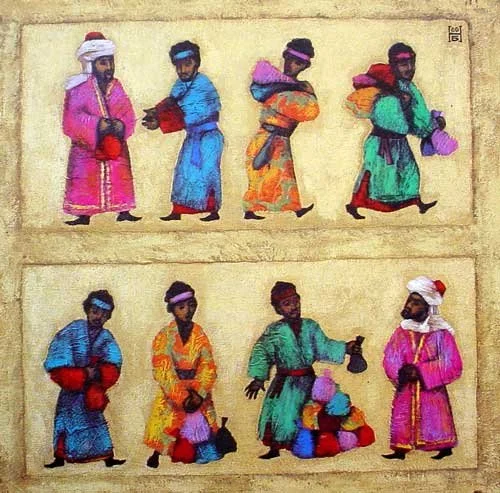
Matthew 25:14-30
“For it is as if a man, going on a journey, summoned his slaves and entrusted his property to them; to one he gave five talents, to another two, to another one, to each according to his ability. Then he went away. At once the one who had received the five talents went off and traded with them and made five more talents. In the same way, the one who had the two talents made two more talents. But the one who had received the one talent went off and dug a hole in the ground and hid his master’s money. After a long time the master of those slaves came and settled accounts with them. Then the one who had received the five talents came forward, bringing five more talents, saying, ‘Master, you handed over to me five talents; see, I have made five more talents.’ His master said to him, ‘Well done, good and trustworthy slave; you have been trustworthy in a few things; I will put you in charge of many things; enter into the joy of your master.’ And the one with the two talents also came forward, saying, ‘Master, you handed over to me two talents; see, I have made two more talents.’ His master said to him, ‘Well done, good and trustworthy slave; you have been trustworthy in a few things; I will put you in charge of many things; enter into the joy of your master.’ Then the one who had received the one talent also came forward, saying, ‘Master, I knew that you were a harsh man, reaping where you did not sow and gathering where you did not scatter, so I was afraid, and I went and hid your talent in the ground. Here you have what is yours.’ But his master replied, ‘You wicked and lazy slave! You knew, did you, that I reap where I did not sow and gather where I did not scatter? Then you ought to have invested my money with the bankers, and on my return I would have received what was my own with interest. So take the talent from him, and give it to the one with the ten talents. For to all those who have, more will be given, and they will have an abundance, but from those who have nothing, even what they have will be taken away. As for this worthless slave, throw him into the outer darkness, where there will be weeping and gnashing of teeth.’
One of my closest friends from college, Emma, is special education teacher— she used to teach in a tough area of Queens, New York, and I remember her telling me a story about a math lesson she was giving her high school students one day. It was some kind of math word problem about, you know, a train getting to the station at a certain time, one of those sort of things… and her students were just not getting it. Emma was getting more and more frustrated, so at one point, she took a break, and re-worded the word problem. She changed the context of the problem to one about text messages. And her students immediately understood the problem and got it right.
I’m telling you this story because that’s what Jesus is doing in this really troubling parable that Elise just read for us. He’s explaining a difficult concept in a context that his followers would understand. It’s another allegory, not too dissimilar from the parable of the ten bridesmaids we talked about last week, about preparation and doing good works to be ready for whatever may be coming in the far future. But it’s really hard to hear this story as anything other than one of cruelty, exploitation of people, wealth-hoarding, and harsh rulers being rewarded for these things—this was everything Jesus preached against! But this was the unfortunate and unjust reality of Jesus’ day—this was the norm. There were slaves or servants tasked with keeping land, property, and money for their wealthy owners or employers, who would get little or nothing in return. It was a deeply hierarchal society run by money and power, in which people were often motivated by fear, resentment, or simply survival.
And remember, as I reminded us last week, Jesus speaks in parables to force us to think critically and creatively, and boy is he making us work our critical thinking muscles with this one. The content is so strange and money-driven, so exploitative, even with the knowledge that it’s not supposed to be taken literally it’s really hard to do the mental gymnastics that feel necesarry for this passage to make sense. But one thing we should be reminded of is how often Jesus had to re-explain things to his discples; how, no matter how much they loved, obeyed, and followed him, they never really understood what he was doing on earth, until he died and was resurrected… and even then, there were some who still struggled to understand or believe. Jesus would tell them, outright, that he was prophesied to died and rise again, and they didn’t get it. They would fight about who was his favorite, they would fight about which one would sit on his left or his right side… they were still stuck in the cruel, hierarchal mindset of their day, unable to understand the type of new world that Jesus was here to begin to usher in.
And so the real tragedy of this parable isn’t the story it self… because this is an allegory, it didn’t happen… the real tragedy is that Jesus’ followers needed a story as cruel and shocking as this to understand what would be required of them in his absence. We have to remember here, this is at the end of the Matthew’s gospel, which means we’re also at the end of Jesus’ life. This is just days before his death, so things are getting pretty urgent. Jesus needs his disciples to understand that while he’s gone, (and not in the three days before he rises from the dead, but rather, after he rises and ascends to haven), they have to keep up the work that he started. They have to spread the good news, they have to tell his story, they have to heal and help and love in his absence; and they have to expand on that healing and love, they have to multiply it. If this spreading of the love doesn’t continue, there will be weeping and gnashing of teeth… because there already is. That’s the world they already live in. That’s the world Jesus came to turn upside down. And in today’s passage, he’s holding a mirror to the society he’s trying to change. He’s putting the radical, new, loving work they’re called to do in the context of the cruel and exploitative world they know, because it’s the only thing they’ve ever known. That is the tragedy, Church—that they can’t comprehend anything that doesn’t fit the context of the brokenness and brutality in which they’ve lived their lives.
You know, it’s interesting—there was an article in the New York Times this past week, and it was about the new crop of religious democrats who were elected to national office over the midterms. And it focused on their use of Matthew 25. (In fact the Rev. Raphael Warnock calls himself a Matthew 25 type of Christian). The author of the article notes that the bulk of chapter 25 is our parable for today, and the one we talked about last week, but that it’s the end of chapter 25 that these democrats used in their campaigns:
…for I was hungry and you gave me food, I was thirsty and you gave me something to drink, I was a stranger and you welcomed me, I was naked and you gave me clothing, I was sick and you took care of me, I was in prison and you visited me.’ Then the righteous will answer him, ‘Lord, when was it that we saw you hungry and gave you food or thirsty and gave you something to drink? And when was it that we saw you a stranger and welcomed you or naked and gave you clothing? And when was it that we saw you sick or in prison and visited you?’ And the king will answer them, ‘Truly I tell you, just as you did it to one of the least of these brothers and sisters of mine, you did it to me.’
But the article’s author says this, about that passage… she writes, that it’s “softer and more soaring in its rherotic.”[i] Soaring, maybe… but softer? I think not. Because the two troubling parables that lead up to this are hyperbolic reflections of the exclusionary and unjust society in which we live. And they’re warnings to be prepared and to continue the work that Jesus started, else we find ourselves living in the same brokenness, repeating our own mistakes and sins forever. But Jesus, our savior, human and divine, aligning himself with the stranger, the hungry, the thirsty, the naked, the imprisoned… that’s not soft. That’s radical… that we have a savior who says no more shall we only look out for ourselves, no more shall we hide our gifts out of fear—no, we will take all that we have been given and all that we have learned from Christ and we will share that love and all of our resources with our neighbor, with the stranger, with the hungry, the thirsty, the naked, the imprisoned. The parables that lead up to this soaring and inspiring end to chapter 25 are reflection of our world. That’s why they are harsh. That’s why they are cruel. Because this world is harsh and cruel.
At the beginning of our parable, when Jesus explains there are three slaves, he doesn’t give any direct descriptions of their qualities or skills, but he does say that the master gives each one of them an amount of money according to each of their own abilities. Considering he gives the third servant only one talent, I think we can assume he doesn’t expect much of him, and that he will be the one made an example of in this story. And when it comes time to settle accounts, we see right away that this third slave never had any intention of doing what he was supposed to do: he tells his master that he knows he’s a harsh man—meaning he was immediately coming from a place of fear—and then he challenges this harsh man, and says, essentially, we worked this land, but here you are reaping the benefit! So he was coming from a place of resentment and anger as well. And I think this is where it’s really easy to get tripped up here, where I definitely did—it’s easy to root for this guy, right? Here’s this wealthy landowner, who just leaves for “a long time” and comes back, and says, “okay, you all better have multiplied my wealth.” The labor supporter and class warrior in me is horrifed by this! But remember—this isn’t actually about money. We don’t know precisely what it’s meant to symbolize, but I think there are several correct answers here… the talents could be good works and acts of service. The talents could be spreading the story of the miraculous life of Jesus. The talents could be spreading the hope and joy that come with that story. The talents could be our modern understanding of talents (this is actually where the word comes from after all)— so it could using our God-given gifts to help our neighbors and our community. When we can grasp that this story isn’t actually about money, but rather about God’s gifts and good news, it’s easier to see how the third slave failed here. It’s easier to understand that maybe this landowner isn’t actually harsh at all. In fact, for the first two servants, he’s so overjoyed with what they’ve done with the talents they received that they “enter into the joy” with him. Like the parable of the bridesmaids before this one, there is great joy in this story, it’s just overshadowed by what comes next. I have to wonder if the those hearing this parable in Jesus’ day would have had their minds blown by the idea of a wealthy and powerful man bring his slaves into his own joy with him. I wonder if we can find it in ourselves to think about this frightening parable in this way— knowing that this isn’t about money; understanding that maybe this master is not, in fact, a harsh man like this third slave implies; realizing that he takes great pride and joy in the first two slaves—who both, despite the fact that the first one made significantly more than the second, both receive the same great reward, and the same great joy. I wonder if we can, in spite of the brutality of this the content of this parable, recognize that the real tragedy here is that Jesus’ contemporaries needed a parable this brutal to understand the fact that in his prolonged absence, they would be tasked with the great responsibility of spreading their own talents—healing, sharing their resources, both material and otherwise; sharing the story of and the love of Christ—to the world, or else risk weeping and gnashing of teeth… and that is to say, risk continuing on in the same broken system that exploits and breaks people down—the same kind of system that was at work in Jesus day, a different-but-the-same kind of system that’s at work today.
And so this is why we have to continue that work today. And we also have to work hard to not come to this work from a place of fear or resentment. The work we’re called to do—and I’ve said this countless times, because it always bears repearing and it will always be true—the work Christ calls us to do is risky work. The work of love and equality is often deeply unpopular, especially with the powerful. It’s not something we can bury or hide from out of fear. It’s not something we can’t avoid out of resentment if we are to call ourselves Christians.
Perhaps it’s a good sign that so many of us probably balked at the content of this parable today. Perhaps it’s a good sign that we find it difficult to understand or relate to such a cruel and wealthy landowner trying to multiply his material wealth— perhaps this is a sign that we have, in fact, progressed a bit since Biblical days so that these concepts of neglect, exploitation, greed, and cruelty that we see on the surface of this parable are appalling to us today. But we know the work is not done. We know that around the world, around the country, people are still exploited and harmed, that people are still hungry, thirsty, imprisoned... we know that we are still called to spread and multiply our figuragive and literal talents until we help to usher in an earth as it is in heaven. And we know also, what the parables of the bridesmaids and the tenants lead to; we know the climax they’re building towards… the fact that just as we did to one of the least of these, we did it to Christ. And so may we continue this work, not out of fear or anger, not out of anxiety or resentment, but out of love, and out of that real possibility of joy that is always present… may we continue that work, together. Amen.
[i] https://www.nytimes.com/2026/11/08/briefing/the-bible-chapter-that-helps-explain-the-new-christian-left.html
